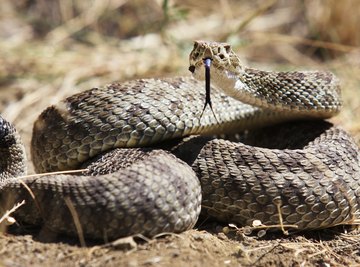
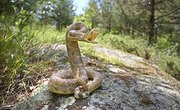
In the reptile world, venom is a powerful defensive tool, but not all species have evolved the metabolism to produce it or the mechanism to deliver it. Those that haven't sometimes mimic the appearance and behavior of their venomous counterparts to take advantage of the benefits of a venom system without actually having one. The bullsnake (Pituophis catenifer), sometimes called the gopher snake, is one of these. It's about the same size as a rattlesnake (Crotalus spp.) and has similar markings. When cornered it can do a convincing rattlesnake impression, but its bite, while painful, is harmless. Rattlesnakes and bullsnakes share the same habitat, and may even hibernate together, so the snake you just happened across on your nature hike could be either one. If you keep your cool, it's fairly easy to tell them apart.
TL;DR (Too Long; Didn't Read)
Bullsnakes look very similar to rattlesnakes and can mimic their behavior. However, they have narrow heads and round pupils, they lack pits above their nostrils and their tails lack rattles.
Check the Tail
Rattlesnakes have rattles; that's why they're called rattlesnakes. The rattles are on the end of the tail, and a new one is added each time after the snake sheds its skin. When threatened, a rattlesnake coils and shakes its tail, and the rattling sound warns interlopers to stay away. Ignore the warning, and the snake will strike. If you corner a bullsnake, it may exhibit the same behavior. However, if you hear a rattling sound, it's either making the sound with its mouth or the snake is moving some dry leaves around with its tail. Whereas rattlers raise their tails when rattling, bullsnakes keep their tails close to the ground, and if the tail isn't hidden by leaves, you'll note the lack of rattles. That's clue number one.
Now Check the Head
Rattlesnakes are pit vipers, and like all such snakes, they have a large, triangular head that narrows dramatically at the neck. Not so bullsnakes. They have narrow heads and relatively thick necks. A bullsnake knows this feature can give away its identity, so when frightened, it will flatten its head to make it look more like that of a rattlesnake. So head shape is not exactly a conclusive identifier. You need more information, and for that, you might have to get closer than you're like.
Whereas the pupils of rattlesnakes are vertical slits, those of bullsnakes are round. Additionally, rattlesnakes have characteristic heat-sensing pits located just above the nostrils. It's these pits that give pit vipers their name. Bullsnakes have no such pits. Together, the combination of head shape, pupil shape and presence or absence of pits provide clue number two.
Markings and Behavior
The markings of bullsnakes are almost identical to those of rattlesnakes, but there is an important difference. Those of bullsnakes are darker, and they turn squarish as you approach the end of the tail. By itself, this isn't much of a clue, but the definitive evidence that you're dealing with an adult rattlesnake is the presence of rattles on the end of the tail. Bullsnake tails lack rattles, and their tails taper off into a point.
If you come across the snake in the dark, it's more likely to be a rattlesnake than a bullsnake. Bullsnakes eat more than rattlesnakes, so they are constantly foraging, and they do so during the day. Rattlesnakes are more opportunistic, waiting for prey to come to them, and this strategy works best at night. Bullsnakes are constrictors and have to search for prey, so if the snake you see seems to be going somewhere purposefully, it's probably a bullsnake. The snake you come across happily sunning itself on a log, on the other hand, is more likely a rattlesnake.
References
Tips
- Do not confuse an attempt to defend itself with aggression; snakes, almost invariably, will avoid human contact unless they are cornered, trapped or otherwise frightened. Pay attention to your surroundings and any situation that may put either you or an unsuspecting snake at risk.
About the Author
Chris Deziel holds a Bachelor's degree in physics and a Master's degree in Humanities, He has taught science, math and English at the university level, both in his native Canada and in Japan. He began writing online in 2010, offering information in scientific, cultural and practical topics. His writing covers science, math and home improvement and design, as well as religion and the oriental healing arts.