Solving polynomial equations can initially seem difficult and confusing. Don't let the letters, called variables, scare you. They represent any number. Once you understand what the terms mean and learn some helpful tips, they really are not too bad. To solve a polynomial is to find the sum of terms. The sum of a polynomial is 0. Try to remember the acronym \"FOIL\" when solving polynomials. FOIL stands for First, Outside, Inside, Last. Let's look at how to solve polynomial equations.
While double checking your work takes longer, it helps avoid simple mistakes.
Put your polynomial in standard form, from the highest power to the lowest power. The power is that small number near the top of the x. Here is an example: 6x² + 12x = -9. You need to move the -9 to the other side of the equal sign to put this polynomial in standard form. Because the number is -9, you need to add 9 to make the right side of the equal sign a 0. Remember, whatever you do on one side of the equal sign you must do on the other side. Therefore, you must add 9 to both sides. Here is the equation 6x² + 12x + 9 = 0 in standard form.
Factor out any common factors. Look at the example again: 6x² + 12x + 9 = 0. You can see that the number 3 can factor out of all three numbers. 3(2x² + 4x + 3)=0. Remember 3x2=6, 3x4=12 and 3x3=9.
Take apart the polynomial, or in other words, write the polynomial in expanded form. Remember FOIL: first, outside, inside, last. 3(x+1)(x+3). Any number times itself is the square of that number; therefore, x times x equals x², that is the first in FOIL. The second letter of FOIL is O for outside: x times 3 equals 3x. The third letter is I for inside, 1 times x equals 1x or x, and last, 1 times 3 equals 3. Remember to combine like terms; therefore 3x +1x equals 4x, the middle term of the equation. Now you know that 3(x+1)=0 or 3(x+3)=0. You know this because the equation is equal to 0 and any number times 0 is equal to 0.
Solve each binomial. 3(x+1)=0, multiply the 3 times the x and the 1: 3x+3=0. You need to make 3x equal -3 because 3+3=0. In order to make 3x into -3, the x must equal -1, so -1 is the first answer of the set. Now look at the second binomial, 3(x+3)=0, and repeat the same steps. Multiply 3 times x and 3, 3x+9=0. Find what x must equal so that when you multiply 3 times x, you will have -9 (because -9+9=0); x must equal -3. You now have the second answer of the set.
Write the answer in set notation, {-1,-3}. You now know that the answer is either -1 or -3.
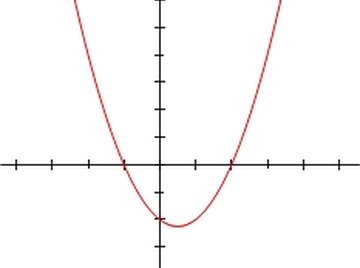
Graph the set and use the f(x) function if required.
Tips
Tips
- While double checking your work takes longer, it helps avoid simple mistakes.
About the Author
Julia Fuller began her professional writing career eight years ago covering special-needs adoption. She holds a bachelor's degree in accounting from Marywood College, is co-owner of GJF Rental Properties as well as a livestock and grain crop farm. She worked for the United States Postal Service and a national income tax service.
Photo Credits
http://en.wikipedia.org/wiki/Polynomial