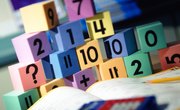
In order for children to learn the abstract concepts that math often presents, they require something tangible to help them develop understanding. Children’s brains learn at the concrete level during elementary school years. Manipulatives give them a concrete tool to actually show them how a concept works as opposed to just listening and memorizing. Using math manipulatives gives them an opportunity to explore new ideas and try out different solutions. Most elementary classrooms offer similar manipulatives, although they may come in varying colors and materials.
Counting Blocks and Linking Manipulatives
Counting manipulatives are some of the most prominent you will see in elementary classrooms. These come in the forms of simple counting items in shapes like animals, transportation or food. Counting manipulatives are colorful so that they can be used for sorting and graphing. Some are interlocking, like cubes, to show relationships between tens and ones. Like interlocking cubes, linking manipulatives are used for a similar reasons. Looking like colorful chains, they can be used to show numerical differences over distance. For example, stretching a 100-link chain next to a 50-link chain shows that it is twice as long.
Money
Money manipulatives are introduced in first and second grade. These are typically in the form of plastic coins that are nearly identical to real coins. You can also use paper money as a math manipulative. Money manipulatives are used to teach money concepts and the vocabulary related to it. A popular way to use this math manipulative is to set up a classroom store and let the students take turns buying and selling items, which allows them to learn in authentic situations.
Telling Time
Since the use of digital clocks has become widespread, children are exposed less and less to analog clocks. One way that schools are combating this deficit is to only provide analog clocks in the classroom and teach time-telling on analog clock manipulatives. Children are taught how to read a digital clock, but as it takes more knowledge and understanding of the concept of time to read an analog clock with hands, teachers emphasize those skills more heavily in math lessons. Clock manipulatives allow children to set the time on individual wooden or plastic clocks, and to use them to solve time equations.
Fractions and Geometry
Pattern and fraction blocks, which come in a variety of shapes and sizes, are commonly used in the elementary classroom to teach the concepts of fractions and geometry. Smaller sizes can be put together to make larger sizes to demonstrate concepts of half, quarter and whole. The same blocks can be used to teach shapes such as rhombus, trapezoid, and different types of triangles. Both types of blocks are used interchangeably as they can be used to teach both concepts.
References
About the Author
Mary Johnson-Gerard began writing professionally in 1975 and expanded to writing online in 2003. She has been published on the Frenzyness Divorce Blog and on Neumind International Pte Ltd. Her book "When Divorce Hurts Too Long—Ouch" was published in 2009. Johnson-Gerard holds a doctorate in educational psychology from the University of Missouri.
Photo Credits
math image by jaddingt from Fotolia.com