
Rules of the Javelin Throw
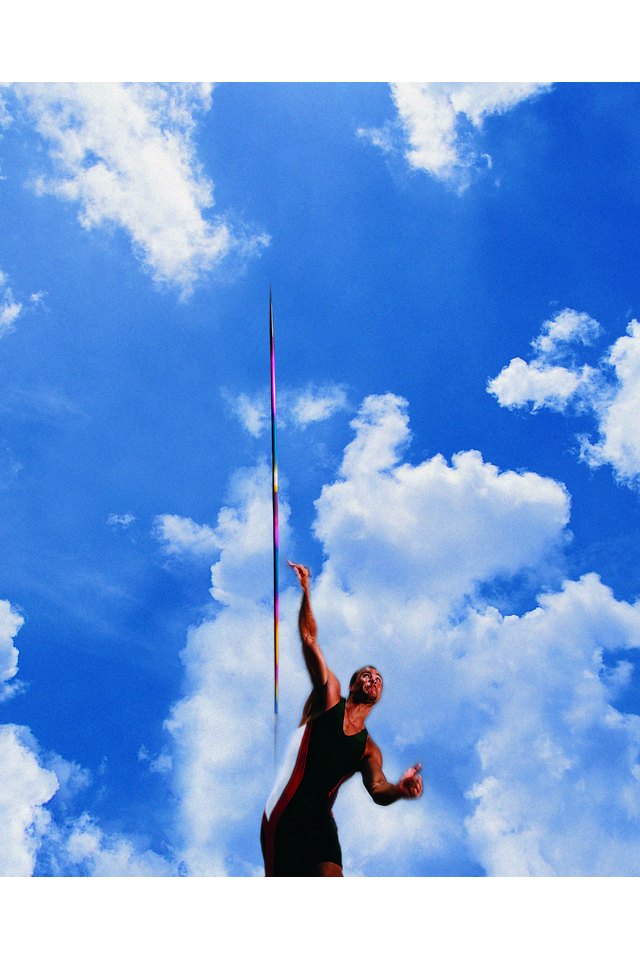
One of the oldest competitive sports, the javelin throw made its ancient Olympic debut in 708 B.C. Despite the elegant simplicity of the sport, the javelin has a comprehensive set of rules that governs the sport at all levels of competition, from high school to international events. With the exception of the javelin's specifications, all rules apply to men's and women's competitions.
Equipment
Men's javelins must be 2.6 to 2.7 meters (8 feet, 7 inches to 8 feet, 10 inches) long and women's javelins must be 2.2 to 2.3 meters (7 feet, 3 inches to 7 feet, 7 inches) long. Men's javelins weigh at least 1.8 pounds and women's weigh 1.3 pounds. Throwers wear shoes with spikes. The shoe cannot have more than 11 spikes, and they must be 12 mm (approximately ½ inch) long and 4 mm (approximately ¼ inch) diameter or smaller. Throwers cannot tape their hands, unless they are injured and are only allowed to use chalk to get a better grip.
Field
The javelin field is 26 feet, 3 inches (8 meters) long by 13 feet, 1½ inches (4 meters) wide. Javelin throwers release the javelin at a designated throw line, or a wooden arc, located at one end of the field. Throwers have a 36.5-meter (40-yard) runway, marked with parallel lines, to move in before they reach the arc or throw line.
Throwing Order
For competitions with more than eight throwers, each thrower gets three trials. When there are fewer throwers, they each get six throws. After the first three throws, the top eight competitors get three more throws each. The thrower with the single best distance wins. If there is a tie, the second best throw by each of the two throwers determines the winner.
Scoring
The javelin does not have to land with the point in the ground, but it has to land with the pointed tip facing forward. The javelin also has to leave a noticeable mark in the ground within the boundaries of the throwing field. Referees measure a throw's distance from the point of the javelin that is closest to the arc or throw line.
Fouls
After each throw, a referee places a white flag for a fair throw or a red flag for a foul. Several types of fouls exist. If a thrower's foot touches or crosses the throw line, he receives a foul. The thrower's foot cannot go outside the lines of the runway. Throwers cannot turn their backs to the field from the time they get into throwing position until the time of the javelin's release. The javelin has to be released using one hand only and it must be thrown up and over the arm in a fluid movement. Throwers cannot leave the runway until after the javelin lands.
References
- Rules of the Game; The Diagram Group
- IAAF Athletics: Javelin Throw
Writer Bio
Heather Potter has more than 10 years experience as a writer. She specializes in travel writing, and her writing has appeared on national websites, including USA Today. She attended Boston University.