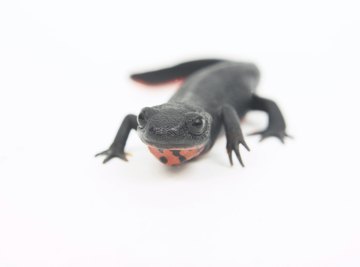

While they may look very similar, salamanders and lizards are vastly different animals. The main difference between salamanders and lizards is their classification: salamanders are amphibians and are classified in the order Urodela along with newts, while lizards are reptiles and are part of the order Squamata which also includes snakes and worm lizards. There are 764 recorded species of salamanders and newts and more than 4,675 species of lizards worldwide. Each salamander and lizard species has unique characteristics, depending on how it has evolved to survive in its environment. Still, some major differences between salamander and lizard species are used to tell them apart.
Salamanders vs. Lizards
Salamanders belong to the vertebrate class Amphibia, a group of organisms that can survive in both aquatic and terrestrial habitats. Examples of amphibians include frogs, toads and caecilians. Salamanders differ from frogs because they have a long, slender body shape and evenly proportioned limbs.
Depending on salamander species and life stage, they can absorb oxygen into their bodies through various methods, including using lungs, gills, and by absorbing it through their skin. Because of their soft, permeable skin and unique adaptations to consuming oxygen, these small amphibians must live in damp, humid or aquatic environments to stay moist.
Unlike amphibians, lizards and other reptiles have protective, hard keratin scales that cover their skin. Because of this, lizards have been able to adapt to a wide range of environments, from arid deserts to lush rainforests and even the ocean. Lizard scales may be smooth, assisting with movement and preventing mud or debris from sticking to them, or they may become thick, forming osteoderms (bony scales or deposits) for extra protection from predators.
Difference Between Salamander and Lizard Sizes
The largest living salamander species is the Chinese giant salamander (Andrias sp.), which grows up to six feet long and weighs up to 140 pounds. The smallest known salamander is the arboreal minute salamander (Thorius arboreus) endemic to Sierra de Juarez, Oaxaca, Mexico. This salamander species measures a mere 0.6 inches long. Most salamander species range between two and six inches and weigh between 0.2 and eight ounces, according to the San Diego Zoo.
Lizards can grow a lot larger than salamanders. The largest and heaviest living lizard is the Komodo dragon (Varanus komodoensis) from the Komodo Islands in Indonesia. The Komodo dragon grows up to ten feet long and can weigh up to 160 pounds. In comparison, the smallest living lizards are the dwarf geckos (Sphaerodactylus ariasae and S. parthenopion). Like the arboreal minute salamanders, these tiny lizards grow up to 0.6 inches long and weigh only 0.004 ounces.
Difference Between Salamander and Lizard Development
Another way to identify a salamander is by looking at its development through adulthood. While both salamanders and lizards lay eggs, salamanders are unique in that they have an aquatic larval stage. Some salamanders such as axolotls (Ambystoma mexicanum) never develop past this aquatic larval stage. Salamanders that breathe through both lungs and gills are called sirens. Newts is the term commonly given to salamanders (such as the tiger salamander, Ambystoma tigrinum) with thicker skin that live most of their lives on land.
Lizards do not undergo any type of metamorphosis, but they do shed their scales as they grow. They hatch from leathery eggs, looking like mini versions of their parents. Most lizards hatch ready to fend for themselves, although some lizard species will stick around to check on their eggs, such as the Texas alligator lizard (Gerrhonotus infernalis), and help protect and care for their young in their early days.
A few species of lizards are viviparous, such as the common lizard (Zootoca vivipara), meaning they give birth to live young. However, the young still develop inside their eggs, just inside the mother. Instead of her laying her eggs into a nest where they develop, they develop and hatch from their egg membrane inside her body.
Salamanders and Lizards are Cold Blooded
Salamanders and lizards are ectotherms, which means they can't generate their own body heat like mammals can. To control their body temperature, salamanders and lizards get heat from their environment. Like lizards, salamanders can be seen basking in the sun, but the amount of time they can spend in the sun is limited because they can't let their skin dry out. When it is too hot, salamanders burrow during the day and are active at night.
As described by Discovery Place, if it is too cold, some salamanders and lizards enter a state called brumation, similar to hibernation in mammals. During brumation, their activity reduces, and the animals' respiration and heart rate slow down. Then, when the weather warms and their bodies warm up, they start moving around again.
References
- San Diego Zoo: Lizard
- San Diego Zoo: Salamander and Newt
- Nature Discovery Place: Ask a Naturalist: Hibernation vs. Brumation vs. Estivation
- Saint Luis Zoo: Amphibians
- Ecological Society of America: Sunbathing: Good for Your Bones (if You’re a Lizard)
- The Wildlife Trusts: Common Lizard
- Animal Diversity Web: Zootoca Vivipara
- Amphibia Web: Amphibian Species by the Numbers
About the Author
Adrianne Elizabeth is a freelance writer and editor. She has a Bachelor of Science in Ecology and Biodiversity, and Marine Biology from Victoria University of Wellington in New Zealand. Driven by her love and fascination with all animals behavior and care, she also gained a Certificate in Captive Wild Animal Management from UNITEC in Auckland, New Zealand, with work experience at Wellington Zoo. Before becoming a freelance writer, Adrianne worked for many years as a Marine Aquaculture Research Technician with Plant & Food Research in New Zealand. Now Adrianne's freelance writing career focuses on helping people achieve happier, healthier lives by using scientifically proven health and wellness techniques. Adrianne is also focused on helping people better understand ecosystem functions, their importance, and how we can each help to look after them.
Photo Credits
Hemera Technologies/AbleStock.com/Getty Images