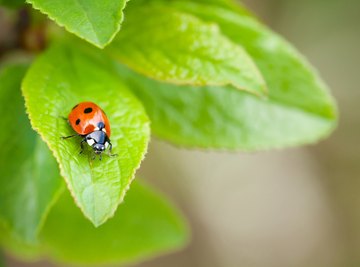
Although ladybugs and butterflies are both insects, and often are found in flowers, they differ in many aspects. Ladybug, ladybird or lady beetle is the common name of the small beetles from the family Coccinellidae, while a butterfly is an individual part of the order Lepidoptera. In addition to biological classification, ladybugs and butterflies differ in appearance, number of species, feeding habits and lifespan.
Appearance
Ladybugs often are smaller than 0.4 inch. Common colors include yellow, orange and red, with black spots, but some species are pure black or brown. Although butterflies do not have hard wing covers like ladybugs, they feature a wider range of colors, sometimes featuring metallic gloss. Butterflies show greater size variations, from the small blue (Cupido minimus), which can have a wingspan smaller than 1 inch, to the giant Goliath birdwing (Ornithoptera goliath) of New Guinea, with an 11-inch wingspan.
Number of Species
Ladybugs species number more than 4,000, but only about 450 are found in North America, including the nine-spotted ladybug (Coccinella novemnotata). The number of butterfly species is much larger, at about 17,500 organized in six families. There are 725 butterfly species in North America, including the common copper (Lycaena phlaeas), California tortoiseshell (Nymphalis californica) and metalmark butterfly (Apodemia mormo langei).
Feeding Habits
Most ladybugs are predators, feeding on soft-bodied insects, such as mealybugs, spider mites and aphids, which also are agricultural plagues. Some species of ladybugs also eat pollen, as well as plant and pollen mildew. Butterflies, on the other hand, feed mostly on nectar and pollen from flowers. A few species can eat decaying materials and tree sap.
Lifespan
After passing through the egg, caterpillar and pupa stages during the metamorphosis process, an adult butterfly lives about one month. Smaller butterflies often live less, while the monarchs and mourning cloaks can have a lifespan of nine months. Ladybugs also go through metamorphosis before becoming adults. After the pupal stage, an adult ladybug can live up to one year.
References
- Cornell University: Lady Beetles
- "Ladybugs"; Suzanne Slade; 2007
- North American Butterfly Association: Butterfly Questions and Answers
- Lost Ladybugs: 4-H Science Toolkit