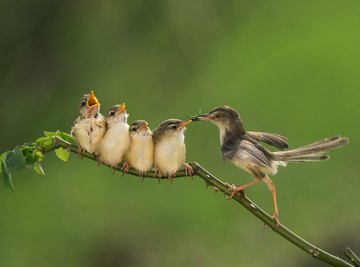

You've probably seen baby birds devouring worms in cartoons, but the reality is quite different. If you're wondering how many worms a baby bird eats, the answer may surprise you. Most baby birds don't eat any worms at all, because most species of birds can't safely eat worms.
TL;DR (Too Long; Didn't Read)
Most birds don't eat worms, whether they are babies or adults. Baby birds are more likely to eat seeds, fruit, nectar, insects, fish and eggs. Whatever a baby bird eats, it should come from its parents. Never try to feed a baby bird by hand.
Worm-Eating Birds
Birds have specific diets, and only a small number of birds can safely eat worms. These include the American robin, the American woodcock, the black-bellied plover and the Eurasian blackbird. Other species may eat worms occasionally, but most birds' diets consist of a variety of seeds, fruit, nectar, insects, fish and eggs.
Baby Bird Diet
A featherless (very young) baby bird needs a lot of food. It keeps its parents busy feeding it every 15 to 20 minutes from sunrise until about 10 p.m. If you find a baby bird on the ground, you may want to help, but it's often best not to. A baby bird may fall out of its nest while its parents are away looking for food. Baby birds and other young animals are often left alone for long periods of time while their parents gather food. If you can safely reach the nest, simply put the baby bird back. If you can't reach the nest, place the baby bird on a branch of the tree near the nest or on a shaded part of a nearby roof, out of the way of cats, dogs and kids. Keep the baby bird in the general area where you found it. Its parents will track it down and care for it. Birds take their babies out of the nest before they are fully feathered, feeding them on the ground for a couple of days until they are flight-ready.
The only way a baby bird should be fed is by its parents or a licensed wildlife rehabilitator. If you feed a baby bird something that's not part of its diet, it could die. Don't attempt to give a baby bird any liquids either, as they get all they need from their food.
Helping a Baby Bird
If you are sure that the mother of a baby bird is dead or if the baby bird is hurt, sick or was attacked by a cat or dog, contact a licensed wildlife rehabilitator through your local wildlife office immediately. This professional is trained to provide care to sick, injured and orphaned wild animals, so they can eventually return to their natural habitat. Tell the wildlife rehabilitator where you are and describe the condition of the baby bird. While you're waiting for the wildlife rehabilitator to arrive, pick the bird up with gloved hands and carefully put it in a well-ventilated, covered box or a paper bag lined with paper towels. Keep the bird warm in a quiet, dark place until the wildlife rehabilitator collects it.
References
About the Author
Claire is a writer and editor with 18 years' experience. She writes about science and health for a range of digital publications, including Reader's Digest, HealthCentral, Vice and Zocdoc.