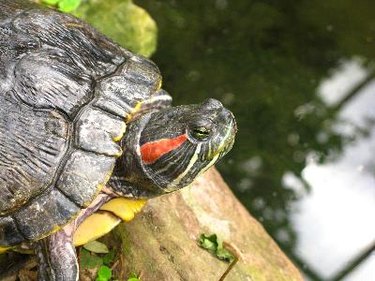
Red-eared sliders are tiny, quarter-sized turtles as babies, but quickly grow into large, 8- to 16-inch adults, depending on gender. They require extremely large aquariums, substantial filtration, and ample lighting. The red-eared slider tank setup is the key to its health, and a well-functioning tank or pond ecosystem will ensure a long and happy life for these hardy turtles.
Video of the Day
Red-eared slider tank setup and size
Select an appropriately sized aquarium or pond. For every inch of turtle, you must have at least 10 gallons of water. This means if you have four 4-inch turtles, you have 16 total inches and will need 160 gallons of water.
Video of the Day
Turtles grow rapidly and will fight or become sick if they are overcrowded. Therefore, it's a wise investment to buy an enclosure that will be sufficiently large for your turtles when they are full grown. For a single turtle, this will mean a 120- to 140-gallon tank.
Red-eared slider habitat setup
Choosing a substrate for the tank is the first step in the a red-eared slider habitat setup. Turtles enjoy digging in the bottom of their enclosure, and a substrate can help trap debris, maintain proper pH, and help the water remain clean. However, red-eared sliders will eat anything they can fit into their mouths and will choke on small, artificial gravel. Large river rocks are an ideal choice for substrate. If you don't use river rocks, choose a clean, debris-free substrate that your turtles cannot fit into their mouths.
Next, establish proper filtration and clean water. Red-eared sliders are very messy and frequently require double filtration. This means that for a 100-gallon tank, you should plan on buying a filter that is sufficient to filter 200 gallons of water. Dechlorinate the water you add to your tank using a commercial water dechlorinator available in pet stores. Follow the instructions on the package.
Red-eared slider turtle tank setup details
Provide your turtles with a basking area. Red-eared sliders spend a significant portion of their time out of water, and must be able to completely dry off. Consequently, the more land you can give your turtles, the happier they will be. During the red-eared slider turtle tank setup, details are important.
For instance, for small turtles, a floating island or piece of wood is sufficient for basking. For larger turtles, you may need to build a rocky land area or cut wood and attach it to the side of the aquarium or pond. The land area should support your turtle's weight and should allow your turtle to become completely dry under the light.
Provide your turtles with 12 hours per day of UV lighting. If your turtles live outside in a pond, you do not need to add a lamp. If they are kept inside in an aquarium, a UVA/UVB bulb can provide them with artificial sunlight. Without UV light, red-eared sliders cannot properly metabolize calcium, and can develop life-threatening metabolic bone disease.
Red eared slider turtle tank temperature
Ensure the water temperature is appropriate for your turtles. Red-eared sliders require a water temperature slightly above room temperature, ranging from 74 to 85 degrees F. An aquarium heater or over-the-tank heat light can raise the temperature to the proper levels. Monitor the temperature frequently to ensure it is not too hot or too cold. At temperatures below 70 degrees, turtles become lethargic, and at temperatures below 65 degrees, they stop eating.