
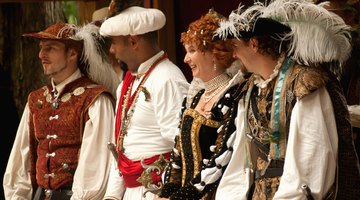


Speaking in the old English style is a talent that is sometimes displayed in the realm of theater and movies. Some actors and actresses are required to speak with an old English dialect in order to assume specific roles. Speaking in an old English manner might be just a personal hobby that you use for your own entertainment or for socializing in certain types of circles. Regardless of why you want to learn, you can begin to learn old English by incorporating some basic translations for modern words and phrases.
Common Verbs
Say "art" instead of "are," as in, "Art thou coming?"
Use "dost" instead of "do," as in "Dost thou play cricket?"
Say "hath" in place of "has" as in, "Hath she any bread?"
Add the endings "est" to many verbs. For instance, you might say, "Needest thou some assistance?"
Pronouns
Use the terms "thee," "thou" or "ye," instead of "you," as in, "Thou must visit soon."
Say "thy" or "thine" instead of "your" or "yours," as in, "It is thy responsibility."
Replace "I" with "me" in certain subject-verb combinations, such as, "Methinks thou art rude."
Random Words and Phrases
Say "hither" instead of "here," and "whence" instead of "when," as in "Whence cometh thou hither?"
Replace "beautiful" with "beautious" or "fair," as in, "The girl was beautious, yea, she was as fair as a rose."
Use "yay" in place of yes and "nay" in place of "no."
Say "naught" instead of "nothing" and "fare thee well" instead of goodbye.
Related Articles








Writer Bio
Charlotte Johnson is a musician, teacher and writer with a master's degree in education. She has contributed to a variety of websites, specializing in health, education, the arts, home and garden, animals and parenting.