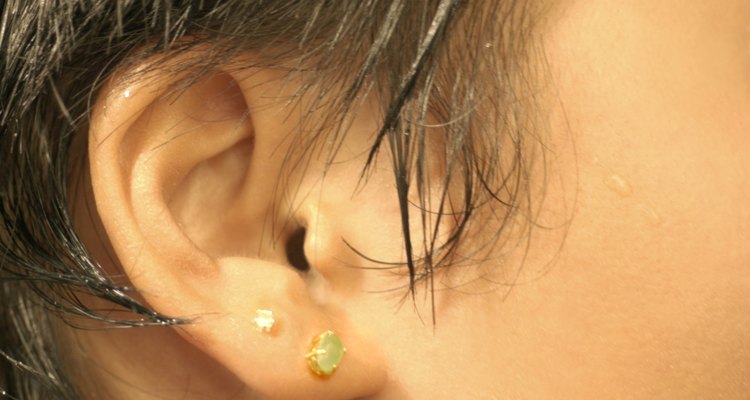
When you have your ears pierced, the piercing professional uses a piercing gun to shoot the earring posts through your ears. The stud posts are sightly thicker than those of standard earrings to open the hole a little wider to ensure that it stays permanently open. The post backing fits over the post very snugly to make sure the studs don't accidentally fall out. Because of the thick posts and the snug backing, taking out the stud earrings the first time can be a bit difficult.
Pour about 1 tbsp. of rubbing alcohol onto a cotton ball.
Wipe your ear lobe with the rubbing alcohol to clean it thoroughly. Wait a few seconds for the alcohol to dry.
Twist the stud using your thumb and forefinger. This will help to loosen the post in your ear and break off any scabs that may have formed inside the ear hole.
Grasp onto the backing with one hand -- again, using your thumb and forefinger -- while your other fingers are still pinching the stud.
Twist the stud while holding the backing firmly. This will help to loosen the backing.
Pull forward on the stud while still holding the backing firmly. Although it takes more effort than removing a normal earring, the post will slide right out of the backing. Gently and slowly, remove the post from your ear. Repeat these steps to remove the other earring.
Clean off the post of a new earring with the rubbing alcohol, then insert the new post into your ear. You can simply throw away your starter stud earrings once removed.
Related Articles
How to Remove Pierced Earrings From ...
How to Change Pierced Earrings

How to Put in a Corkscrew Nose Ring

How to Clean a Tongue Ring

Taking Care of Gauged Ears

What to Do When a Nose Ring Falls Out

How to Take Out a Lip Ring Stud

Instructions on How to Insert L-Shaped ...
How to Put in a Captive Bead Lip Ring

How Long Should I Wait to Get My Nose ...

How to Put in a Curved Nose Ring
How to Remove a Tongue Ring

How to Gauge Your Ears with Tapers
How to Tighten Plastic Sunglasses Frames
How to Remove a Navel Piercing
How to Pierce Your Navel

How Do They Pierce Your Ears With ...
How to Remove a Captive Navel Ring
How To Put in a Nose-Ring Ball

How to Remove Starter Earrings for ...
References
Writer Bio
Andrea Griffith has been writing professionally since 2005. Her work has been published by the "Western Herald," Detroit WDIV, USAToday and other print, broadcast and online publications. Although she writes about a wide range of topics, her areas of expertise include fashion, beauty, technology and education. She holds a Bachelor of Arts in journalism and English from Western Michigan University.
Photo Credits
Thinkstock/Comstock/Getty Images