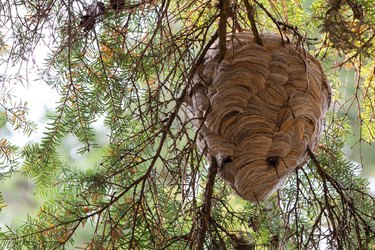
Yellow jackets and hornets are often confused with each other due to their similar yellow and black striped appearance. However, there are distinct differences between the two that can help you distinguish one from the other. Both pack quite a powerful sting, but though yellow jackets may be more aggressive, the sting of the hornet is much more painful. Perhaps the easiest way to tell the difference between yellow jackets and hornets though is by looking at the location of their nest. While yellow jackets make nests in the ground, hornets have nests above the ground. In this article, we'll explore even more key characteristics of yellow jackets and hornets and provide tips for identifying and distinguishing them.
Common Species
Video of the Day
In the United States, the Eastern yellow jacket (Vespula maculifrons) and the Southern yellow jacket (Vespula squamosa) are the two most common species of yellow jackets. These insects are small, reaching only about half-inch in length, and are black and bright yellow in color. They tend to build their nests underground and, although you may not want to get close enough to check, yellow jackets also have tiny waists.
Video of the Day
The most common hornet species in the U.S. are the baldfaced hornet (Dolichovespula maculata) and the European hornet (Vespa crabro). Hornets have much wider waists than yellow jackets and are often black and white rather than black and yellow. Hornet species that are black and yellow tend to be much duller than yellow jackets, so you can still tell them apart. Larger than yellow jackets, hornets grow to three-quarters of an inch long. They make large, round paper-like nests that are typically found hanging from trees, roof eaves, decks, and porch roofs.
Where You'll See Hornets and Yellow Jackets
Both hornets and yellow jackets make large, round nests that look like paper. They make this paperlike substance themselves after chewing on tiny slivers of wood. There are a few exceptions, but for the most part, you will find hornet nests hanging from trees and roof eaves as well as under decks and porch roofs. Yellow jackets, on the other hand, tend to build their nests underground. You may see large numbers of them flying low to the ground near their nest.
You're also more likely to find your outdoor activities disturbed by yellow jackets. Sugary foods and drinks attract these insects, so the bug hovering around your soda can at the family picnic is probably a yellow jacket. Many hornet species are carnivorous, however, and are far more likely to go for your burger than your beverage.
Behavior and Aggression
Both hornets and yellow jackets can sting multiple times, and this fact has given them a bit of a bad reputation. It's true that both insects can do some damage, and neither will hesitate to do so when defending their nests, but these insects only turn aggressive when provoked. As long as you leave them alone, they will typically return the favor.
Entomologists consider both insects beneficial. They're excellent garden pollinators, and both kill aphids, caterpillars, and other garden pests. Hornets simply eat these insects. Yellow jackets and hornets both feed them to their larvae.
Eliminating Hornets and Yellow Jackets
If you encounter a yellow jacket or hornet nest in a location that makes avoidance difficult, you may need to remove it. It's best to wait until nighttime when the insects are less active and use an insect spray that allows you to stay a safe distance away from the nest during applications. Wear protective clothing and have a planned exit strategy in case something goes wrong. If you're unsure, it's always best to call a professional exterminator for help.