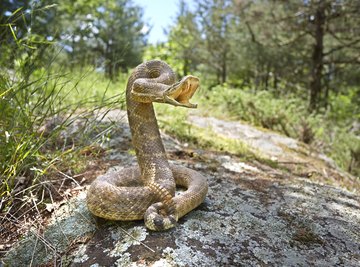
The markings and body shape of adult rattlesnakes makes them easy to spot, and babies have the same markings. They may not appear quite as dramatic, though, because their bodies are smaller and thinner, and they don't have rattles. A baby rattlesnake carries a more potent venom than an adult, but its bite is probably less dangerous. Nevertheless, you don't want to be the person who finds out that, in certain circumstances, a baby rattlesnake bite could be fatal, so it's best to know how to identify one so you can react appropriately.
Pit Viper Characteristics
Rattlesnakes have two well-defined pits located under their nostrils, which allow them to sense heat and hunt warm-blooded prey. These pits are discernible on baby rattlers as well as adults. Another distinguishing feature of rattlesnakes – and pit vipers in general – is a large, triangular head that tapers quickly into a neck that is narrower than the rest of the body. Although young rattlers are more slender than adults, they still have thick bodies that taper at both ends, and the triangular head is evident.
Shape and Coloration
A feature that distinguishes all species of rattlesnakes from non-venomous snakes is the size and shape of the body. Whereas non-venomous snakes have long, tapered bodies, the bodies of rattlesnakes – even young ones – are comparatively thick in the middle. Young snakes aren't as long as adults, which can reach lengths up to 8 feet. By comparison, babies can be anywhere from 6 to 12 inches in length – not much longer than a pocket knife.
While markings differ, most rattlesnakes have highly distinctive patterns on their backs – often diamond shaped. The colors help the snakes to camouflage themselves, so the markings on desert rattlers are sand colored, while those on timber rattlers resemble leaves. Baby snakes have the same markings as adults, and the patterns may be even brighter and more noticeable.
Habitat and Behavior
Rattlesnakes make many people think of the desert, but they also live in woodlands as far north as southern Canada and as far east as the Atlantic coast. Rattlesnakes like to make dens in rocky crevices, and they hibernate in these dens in colder climates. They come out of their caves on warm days to bask in the sun on rocks or other open places. Young snakes quickly adopt these behavior patterns, and because they are smaller than adults, they aren't as easy to notice. If you step over a rock without looking, you might easily step on one.
Baby Rattlesnakes Don't Have Rattles
A rattlesnake's most distinguishing feature is its rattles, but baby rattlers don't have rattles until they shed their skin for the first time. Instead, the baby has a little knob – called a button – on its tail. When an adult rattlesnake feels threatened, it coils, rattles and hisses all at the same time. Young snakes may coil and hiss, but you won't hear a rattling sound. You shouldn't ignore the hiss of any snake, but it's a grave warning when coming from a rattlesnake, even a baby one. Baby rattlesnakes don't have as much venom as adults, but it's more potent.
References
About the Author
Chris Deziel holds a Bachelor's degree in physics and a Master's degree in Humanities, He has taught science, math and English at the university level, both in his native Canada and in Japan. He began writing online in 2010, offering information in scientific, cultural and practical topics. His writing covers science, math and home improvement and design, as well as religion and the oriental healing arts.