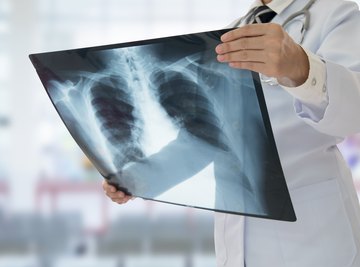

The skeletal system includes not only bones, but also cartilage, ligaments, tendons and other tissues that are essential for everyday functioning. Anyone who has ever experienced Halloween has had at least some exposure to the human skeleton, and if you've been in enough doctor's offices, you've probably seen a high-fidelity representation of a skeleton.
The skeleton's more obvious roles include structural support, locomotion and protecting the internal organs. Under the radar, the bones produce various types of blood cells and store minerals, particularly calcium, that can be liberated and used elsewhere in the body.
Components of the Skeletal System
The skeletal system includes four basic components, although some sources include a fifth, the joints. The four are the bones, which make up most of the mass of the skeletal system; cartilage, which acts mainly as padding; ligaments, which usually connect bones to bones; and tendons, which join muscles to bones. The system has two divisions, the axial skeleton and the appendicular skeleton.
Bones are made of a composite tissue, with a high fraction of the mineral calcium. Adult humans have 206 bones; young children may have more because some bones fuse during early maturation. The bones notably provide structural support, giving the body form and rigidity and allowing for walking, running and more complex movements. But bones are also metabolically active as the marrow in the interior of bones is where blood cells are made. Bones also feature epithelium, adipose tissue and nervous tissue
Tendons connect muscle to bone. They consist of tightly packed bundles of the protein collagen arranged in parallel. They are usually encased in fluid-filled sheaths when they abut other tissues, to decrease friction and increase padding. They act to focus a muscle's effort on a physically small portion of bone, better allowing muscles to serve as levers.
Ligaments connect bones to each other. They do so in a relaxed manner, without any pulling between them since no muscles are involved. They are similar in composition to tendons, although the fibers they are assembled from are often more variable. They sometimes have a degree of elasticity, but are not really considered "stretchy."
Cartilage is found in joints between bones and is made of material intermediate in firmness between bones at the hard end and tendons and ligaments at the softer end. It contains both collagen and chondroitin sulfate. Its appearance is like that of a sponge, with pores called lacunae between the solid portions. It comes in a number of forms, the most common of which are hyaline cartilage, elastic cartilage, fibrocartilage and calcified cartilage.
Components of the Axial Skeleton
The axial skeleton is so named because it includes the 80 bones along the long axis of the body above the pelvis. From top to bottom, it includes the skull, mandible (lower jaw), hyoid bone (under the chin), vertebral column, ribs and sternum.
The skull alone contains 22 bones. Seven additional bones, including the ossicles of the inner ear and the hyoid, are associated with the skull. The skull serves to house and protect the brain. It is connected to the top of the vertebral column.
The vertebral column includes 24 bones, along with the sacrum at the base and the coccyx (tail bone) at the lower end of the sacrum. The vertebrae protect the spinal cord and allow for upright posture.
Humans have 12 pairs of ribs, which serve to guard the heart, lungs and other internal organs of the thorax. Between them in the front of the body is the sternum, or breast bone.
Components of the Appendicular Skeleton
The appendicular skeleton, so named because it includes the body's appendages (arms and legs in humans), features 126 bones.
The long bones of the arm include the humerus of the upper arm and the radius and ulna of the lower arm. The long bones of the leg are the femur, or thigh bone, and the tibia (shin bone) and fibula of the lower leg. The primary pelvic bone is the ilium; the points you can feel at the top of each of your hips are called the iliac crests.
The hands (26 bones each) and the feet (27 apiece) together include over half of the bones in the human body – 106 out of the total 206 listed in most texts. The hands and feet each have 14 phalanges, which are the small joints of the fingers and toes (each finger has three, the thumb two; the second through fifth toes also have three each, while the big toe, like the thumb, includes two). Each hand and each foot has five bones that connect phalanges to the wrist and ankle bones respectively; these bones form the scaffolding of the palms (the metacarpals) and the arches of the feet (the metatarsals). Finally, each wrist has eight bones, while each ankle includes seven.
Skeletal System Organs and Tissues
Each bone is actually an organ in its own right. Each long bone includes a diaphysis (shaft) and an epiphysis at each end. The metaphyses are the areas between the diaphysis and the epiphyses; this is where growth occurs in these bones in younger people – at the epiphyseal growth plates.
In addition to the long bones of the appendicular skeleton, the body includes various other types of bones. One of these are short bones, which include the irregular bones of the wrist and ankle. Flat bones, which include the sternum, the ilium and the skull bones, are mostly protective in function, and in the pelvis, their considerable surface area allow for many different muscles to attach to the same general part of the skeleton. The vertebrae and the hyoid are irregular bones, which have functions determined by their location in the body. Finally, there are the sesamoid bones, which mainly protect tendons and most notably include the patellae (knee caps).
The marrow in the middle of bones comes in two forms, yellow and red. Yellow bone marrow contains adipose (fat) tissue, which can be released to serve as an energy source for other tissues. Red bone marrow is where blood cells are manufactured, a process called hematopoiesis. Red blood cells, white blood cells and platelets are all produced in this type of marrow.
Skeletal System Function
Without the joints, the skeletal system would not be able to engage in the numerous elegant functions of movement that give vertebrate animals their form and function. Joints come in three types:
Synarthroses are immovable joints and include the sutures between the skull bones, the points of contact between the teeth and the mandible, and the joint that is located between the topmost pair of ribs and the sternum. Amphiarthroses are joints that permit a small amount of movement. These include the joint between the tibia and the fibula just above the foot and the pubic symphysis that joins the two sides of the pelvis in the front of the body at the waist Diarthroses are joints that allow full movement, and include many of the joints in the upper and lower limbs, such as the elbow, shoulder and ankle joints.
The minerals in bones, including calcium and phosphorus, can be released from bone into the bloodstream for the maintenance of metabolic functions as calcium ions participate in muscle contraction, and phosphates are a critical component of DNA and molecules important in energy transfer and release.
References
About the Author
Kevin Beck holds a bachelor's degree in physics with minors in math and chemistry from the University of Vermont. Formerly with ScienceBlogs.com and the editor of "Run Strong," he has written for Runner's World, Men's Fitness, Competitor, and a variety of other publications. More about Kevin and links to his professional work can be found at www.kemibe.com.