Things You'll Need:
- Sketchbook or drawing paper
- Ebony pencil or 6B pencil
- Kneaded eraser
- White vinyl eraser
- Workable matte fixative
- Photo references of people with straight or wavy light hair.
- Tortillon or stump (Pointed cardboard blender)
-
Step 1
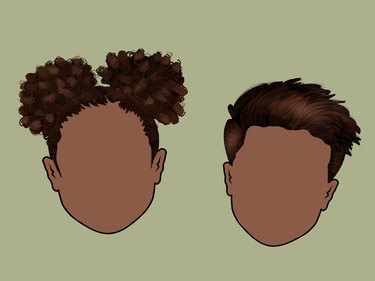
Three cartoon heads with different types of cartoon hair.One of the big challenges in drawing realistically is to draw what you see, not what you know is there. We know what hair is, after all. It's a lot of very fine thin strands growing out of the scalp of someone's head. So the natural impulse in drawing hair is to draw as many of those as possible starting at the scalp and going down to the ends of the hair, like the hippie in my first sketch.
Now, this is great for a cartoon. You can do curly cartoon hair too. Some cartoonists just outline the shape of the mass of hair and leave it at that -- it looks right, in some ways it looks better than the first example because it has some volume. Cartoon hair simplifies hair and makes a sketch read like a person, the point of cartooning is the caption, the gag, the idea. As long as you can recognize what the artist drew, it's good enough to carry the idea.
True realistic pencil drawing is much more powerful. It looks as if you can reach out and touch the hair, feel its softness. Sketch a head of hair, small and simple, the best you can now. Date it and set it aside, or if it's not occupying the whole page of your sketchbook, just leave it off to the side and keep drawing. You will be very surprised to see your progress in just a few exercises -- and never see hair quite the same way again. -
Step 2
Sketch of woman's head with hair blocked in by shape of massLook at a magazine photo of someone with light colored, blonde or white medium or long straight hair. It can be a little wavy, but we're not dealing with curls or dark hair yet in this step. Study the photo carefully. You can see that different masses of hair are separate from others, maybe held by a clip or tie. They flow across each other. They have light and dark areas, shadows and highlights. But you can tell the direction of the hair in these areas. My chosen photo is an older woman with white hair neatly tied back, the clip and bun aren't visible at the angle her head's turned but there's a nice sweep to it.
Study your photo and do an outline sketch the way I'm doing. Keep in mind that if you chose a light haired person, your outlines are really part of the background. The line thickness should be on the outside of the hair area in your contour drawing of the head, also outside the boundary of the profile.
Because her hair is white with a little darker gray in it in some places, I've deliberately made the blocking-in lines very light. If you draw lightly and place one of those lines wrong, just erase and move it. The white vinyl eraser will remove lines completely, the kneaded eraser will lighten them if you got them right but think they're too dark. Scan is darkened to show the light sketch lines for profile and hair shape. -
Step 3
Dark background added, shading on face and clothing done lightly. Drawn from negative space, the shapes are prominent.Sketch in a dark background around the head you're drawing. This will show the hair mass shape a lot more accurately before starting to shade the hair so that it looks real. Also shade around the face where it shows against the background. This is called drawing from the negative space, and it is a good way to get outlines accurate.
It also eliminates outlines as such in favor of a realistic boundary between dark and light. Place dark backgrounds behind light elements in a realistic drawing, light backgrounds behind dark elements. This will give your drawing a lot of drama, make it look better than life.
Lightly shade the face and skin tones. I left the shirt white even though in my photo it's light blue, so as to provide some contrast. Simplify the folds of cloth on the clothing but don't eliminate them. The dark vest helps give some contrast to the shirt and to the skin tone where the shirt shadows it. So far this is a light, moderately realistic sketch with unreal hair, hair blocked in as no more than a white mass. -
Step 4
Step four, shading blended with tortillon for smooth texture.Use a tortillon or stump to blend the shading on the skin tones, starting from the darkest areas and working into light areas that were left white in the previous step. This will darken the skin tones. Adjust comparing to the photo by using the kneaded eraser to lift any area of skin tone that needs to lighten. Squish it into a point and press only on the area you want lightened, then peel off.
After the face is shaded with the tortillon, blend the clothing shading as well to have a consistent texture. Hair is still a white mass that is now very prominent against the other textures in the drawing.
Spray lightly with workable fixative when you are satisfied with the shading on the face, clothing and background, as a barrier layer. The hair will have a very different texture. This barrier layer will reduce smudges when you're doing the hair. -
Step 5
Locks of light hair, shaded with flicking strokes from the shadow toward the highlight.Sharpen your Ebony pencil to a fine point. The texture in the hair will be very different from the texture on skin and clothing, depending on some very fine lines that go heavy and feather off in the right curving direction with a flick.
Practice some curving strokes on the side. They start where a clump of hair begins, go in the direction of the flow of the lock, and fade out as they approach the highlight. With white or pale blonde hair, leave very large highlights and only flick hair texture in at the shadows. Be sure to pay attention to where those shadows are on your photo reference.
Do not connect the strokes across the highlight at all. Let them fade out entirely within one lock of hair. Later we'll show how individual locks can turn into ringlets and curls too! -
Step 6
Finished drawing showing hair lighter than subject's skin tone.Lightly shade the hair on the figure, going into the shadows between locks. Look at where the hair originates and how it folds and curves. Shape the hair with the direction of your strokes. Less is more. Begin just at the edges and slowly add more detail as you go, but don't completely go over the highlights. On the curl at the top of the forehead, make the edge of it a little jagged as individual small clumps of hair stick out loosely.
Use the tortillon to shade just in the very darkest darks, flicking in the same direction as the hair strokes and not quite as far. Shade with it under masses of hair, so that they have a soft shadow and the lines of the hair detailing are still distinct.
Spray your drawing with a light coat of workable matte fixative. Sign and spray one last time for a final coat.
Next step we'll do some isolated ringlets, bangs and other shapes hair can take that you can use on other realistic drawings of people.
By keeping larger white highlights in her hair and limiting the number and size of white highlights on her face, we've shown this lady's hair is lighter than her skin even if some shadow details are darker than her general skin tone. It's easy to do this in color too, in some ways a little easier. Just use skin tones like peach, medium brown and reddish brown for the face but use cool light gray and blue-gray shading in her white hair. In blonde hair match the color of the shadows to your reference, it is probably either a reddish brown or a cold grayish brown.
If you don't find a reference you like or find it easier copying a drawing, copy Silver Hair in detail through all the steps. -
Step 7
Braid, curls and ringlets shaded and unshaded to show shape.Braids, ringlets and curls can be shaded in the same way. Sketch the shape of the ringlet or braid -- the neat little coiled ringlet to the right has been left unshaded at the bottom to show its shape. Then shade in the direction of the coil of hair, leaving a big shining highlight between the ends. Shade only where it dips or where a shadow from another curl falls on it.
In drawing curly hair it's good to follow the reference as precisely as you can. Curls go every which way and sometimes crinkle or have odd shapes. Instead of drawing each curl as precisely as the foreground curls, pick out the most interesting ones in detail and then loosely sketch the ones in the background. Shade but don't go into detail on underlayers and background hair.
Or you can fill the hair area with a light shade of gray by smudging graphite powder, then pick out highlights with your kneaded eraser to show individual curls, then shade around those curls. Leave as much to the imagination as you draw distinctly though, otherwise curls can become too distracting a texture. Ringlets framing the face or forehead can be drawn in more detail than curls and swirls farther from the face.
In color if you use a light brown for this style of drawing and shade it through pale beige to reach white highlights, it will be dramatically blonde. For strawberry blonde, use a more russet color like terra cotta and shade accordingly.
Sketch and doodle locks of hair constantly to get the rhythm of strokes that start dark and feather off in the direction of the hair, or shadows in the middle of curls that feather off on both ends. For those strokes, practice a rocking motion lifting your pencil from the paper and gradually swinging it down again in a shallow curve, back and forth. Get used to turning them in different directions, spreading them or narrowing them, describing different lock shapes. Ringlets are good practice and fun to do as a doodle, so are braids.
Sketch darker hair that has sharp short bright highlights or smudged-gray highlights too, depending on how shiny it is. Once you get used to drawing hair this way, it'll feel so natural you can apply it to anything -- including sometimes fur on long haired dogs and cats, like Afghan Hounds or Maine Coons. Have fun!


Comments
smart42 said
on 8/26/2009 i used to have trouble doing this but i think i'm getting the hang of it