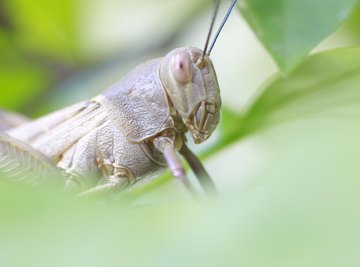
The many species of grasshoppers and locusts belong to the Acridoidea family in the order Orthoptera. Locusts are a type of grasshopper, but differ from other grasshoppers in their ability to migrate and swarm. Cicadas belong to the Cicadidae family in the order Hemiptera: previously, cicadas were listed in the now-eliminated order Homoptera. Cicadas are sometimes mistaken for locusts because periodical cicadas (Magicicada septendecim) appear in huge numbers when they first emerge from the ground. You can identify cicadas by the loud sound they make and their unique life cycle.
Locusts and Grasshoppers Look Similar
Locusts are a type of grasshopper. Both locusts and grasshoppers have large hind legs, which allow them to hop. Female locusts and grasshoppers are larger than their male counterparts. The main difference between locusts and other grasshoppers is the ability of locusts to swarm, while most grasshoppers never or rarely swarm. When locusts begin to swarm, the female-to-male size ratio often decreases. Both grasshoppers and locusts come in green, brown or dark yellow, but the color or color pattern of locusts often changes when they enter their swarming, or migratory, phase.
Locusts and Grasshoppers Differ in Behavior
Both locusts and other grasshoppers are herbivores, and in high numbers, can cause serious crop damage. Locusts undergo a solitary phase and a gregarious phase. They behave like grasshoppers in the solitary phase, but they mass in large groups during the gregarious phase and often bunch up and fly together for long distances. They can devastate a crop field or landscape. Scientists discovered that the brain chemical serotonin can turn solitary locusts into gregarious, swarming insects. The trigger that transforms solitary locusts is touch. When the locust numbers increase, physical touch is unavoidable and locusts begin to produce serotonin.
Cicadas Look Different From Locusts and Grasshoppers
Cicadas come in two major variations: annual cicadas, belonging to many insect species, and periodical cicadas. All cicadas are dark, stout insects with large heads and transparent wings. Periodical cicadas are usually smaller than annual cicadas: 25 millimeters (1 inch) and 38 millimeters (1 1/2 inches), respectively. Periodical cicadas have reddish eyes, while annual cicadas have dark eyes. Cicadas, like locusts and grasshoppers, have three pairs of legs. All legs, unlike the legs of locusts and grasshoppers, are about the same length. Despite the differences in appearance, periodical cicadas with a 17-year life cycle are commonly called the "17-year locusts."
Cicadas Have Unique Life Cycles
Immature cicadas spend a long time in the ground before they emerge for a brief life as an adult. After the eggs laid by female adult cicadas hatch, nymphs, or immature cicadas, emerge and burrow into the ground. Annual cicada nymphs live for one or three years underground, feeding on the juices of plant roots. Periodical cicada nymphs stay below the surface for 13 to 17 years before they emerge in great numbers and climb up trees and other vegetation. Emerging cicada nymphs shed their outer skins and devote their adult lives to mating. Male cicadas sing, producing a high pitched, droning sound, to attract the silent female partners. After mating, females lay eggs in woody twigs before they die.
References
- New Mexico State University: Grasshoppers
- Food and Agriculture Organization of the United Nations: Locusts
- North Carolina State University: Grasshoppers
- National Public Radio: Serotonin Boosts Sociability in Locusts
- Pennsylvania State University Extension: Periodical Cicada
- University of Kentucky Entomology: Cicadas
About the Author
Based in Connecticut, Marie-Luise Blue writes a local gardening column and has been published in "Organic Gardening" and "Back Home." Blue has a Ph.D. in biological sciences from the State University of New York at Stony Brook and wrote scientific articles for almost 20 years before starting to write gardening articles in 2004.