
If your friend gave you one cup of solid ice, and another gave you one cup of liquid water, which one is heavier?
Our instinct is sometimes to think that solids are heavier, but in fact liquid water denser than solid water. By knowing how to calculate weight from density, we can quickly see that the cup of water is heavier.
What is Density?
The density of some substance tells us how compact or spread out it is. We can describe a volume density, mass density, or any other kind of density.
For example, city planners often think about different densities, such as housing availability or grocery stores, to figure out where to build certain buildings.
In general, a density is usually a quantity such as mass, divided by an area or volume.
A weight density would therefore describe how the weight of some object is distributed in some area, or volume. More likely, you will use mass densities, since mass and weight are related by the acceleration of gravity, which can change depending on where you are on the surface of the Earth (and even more so if you're on a different planet!).
Tips
The density of an object describes how compact of spread out it is. A weight density describes the weight distribution of the object, in some area or volume.
An Example of the Density Formula in Chemistry
Let's say our lab has two compounds: A and B. Compound A is a ball that has a volume of 30 cm3 and has a mass of 50 g. Compound B is a perfect cube with sides measuring 6 cm, and has a mass density of 500 kg/m3. What is the density of compound A, and which compound is heavier?
We can quickly calculate the mass density of compound A:
But in order to compare the densities of A and B, we have to convert the density to be the same units.
To convert from kg/m3 to g/cm3, we need to use the conversions: 1 m3 = 1,000,000 cm3 and 1 kg = 1000 g. Therefore, the mass density of compound B is 0.5 g/cm3. Now we can simply compare the mass densities and notice that compound B is less dense than compound A.
Accounting for Weight
To answer which is heavier, we need to calculate the weight of each compound from its mass and the acceleration of gravity. We know the mass of compound A, which is 0.05 kg, so it's weight in newtons is 0.05 kg × 9.8 m/s2= 0.49 N.
But for compound B, we need to calculate the volume it occupies, then it's mass from the mass density. We can calculate the volume of compound B because it is a perfect cube: the volume is (6 cm)3 = 216 cm3.
The weight of compound B is the volume times the density: 216 cm3 times 0.5 g/cm3, or 108 g. The weight is therefore 0.108 kg times 9.8 m/s2, or 1.07 N.
The Difference Between Mass and Weight
Weight is the quantity that describes the force of gravity on an object due to it's mass, and the local acceleration of gravity. Therefore, the weight of an object can change if you move it from a valley to the top of a tall mountain, because the acceleration of gravity decreases as we move away from the Earth's core.
Mass, however, can only change if the object is physically changed and some of it's matter is removed.
It is important to remember the difference between mass and weight.
References
About the Author
Lipi Gupta is currently pursuing her Ph. D. in physics at the University of Chicago. She earned her Bachelor of Arts in physics with a minor in mathematics at Cornell University in 2015, where she was a tutor for engineering students, and was a resident advisor in a first-year dorm for three years. With this experience, when not working on her Ph. D. research, Gupta participates in STEM outreach activities to promote young women and minorities to pursue science careers.
Photo Credits
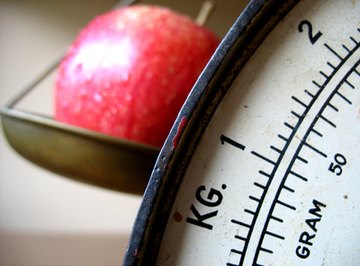
apple on scale (focus on scale) image by Pontus Edenberg from Fotolia.com