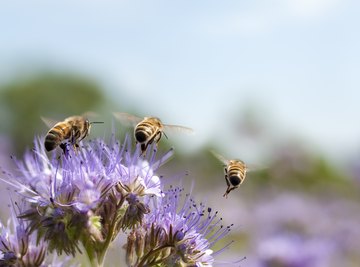
Bees, wasps and hornets have similar appearances and coloring, but perform different functions in our ecosystem. Bees rarely sting humans and never sting more than once. They are greatly beneficial in producing useful honey and beeswax, and instrumental in pollinating plants. Wasps do not pollinate or produce honey and wax, but can be beneficial in feeding on other insects. Unfortunately, wasps become a nuisance when they swarm around human garbage, food and drinks. Wasps and hornets, a subset of wasps, can also sting repeatedly without dying. Learn to tell the difference between bees, wasps and hornets to avoid harming the wrong insect.
Examine the insect’s body for fuzz. Bees have fuzz on their bodies, while wasps are almost always smooth.
Examine the size. In general, bees have a rounder, fatter abdomen than wasps, which tend to be narrower in that area. Some wasps have a long, threadlike waist connecting the thorax with the abdomen. Hornets have a fatter abdomen compared to other wasps, and as such may be mistaken for bees. Hornets, however, are uncommon in the United States except for the West Coast.
Pay attention to the insect’s activity. Bees frequently fly around flowers, particularly yellow- and blue-colored blossoms, to gather pollen. Wasps sometimes feed on nectar, but may also gather around garbage, human food and sweet drinks. Most bees are not aggressive unless provoked, while wasps may be extremely aggressive.
Inspect the insect’s nest, if possible. Hornets and wasps frequently make nests out of paper or mud, while honey and bumblebees build nests out of wax.
Learn some common U.S. bees and wasps: Honeybees have clear wings, a fine coating of fuzz and a banded yellow-orange and black coloration. Bumblebees are significantly fuzzier than honeybees and have darker wings. Yellowjackets look like honeybees, but without the fuzz and with more intense yellow coloration. Most insect stings in the U.S. result from yellowjacket wasps. Paper wasps have slender bodies and reddish brown/yellow or black/yellow stripes.
Consult a field guide to identify other types of wasps and bees. Wasps vary in their aggressiveness, and some are harmless and quite beneficial.
References
- Mental Floss: Bee vs. Hornet vs. Wasp
- “Field Guide to Insects and Spiders of North America”; Arthur V. Evans; 2007
About the Author
Christina Sloane has been writing since 1992. Her work has appeared in several national literary magazines.