
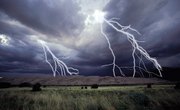
For children, thunder can be scary. Honestly, many adults find loud claps of thunder a little frightening, too. Thunder, loud and scary as it might be, is fairly simple to understand. Next time your child is frightened by thunder, or even just curious, you might need some help explaining what is really going on.
Why Does It Thunder?
For starters, thunder is caused by lightning. So to understand why thunder happens, it's important to talk about lightning first.
When dark, puffy thunderclouds make rain, little bits of ice and water bump into each other inside the cloud. As the water and ice bump into each other, an interesting thing happens: electricity builds up in the cloud. This happens because, as liquid water bumps into ice, it takes some electrons with it. This gives the water a negative electrical charge and the ice a positive one. As water falls out of the cloud as rain, it takes those electrons with it.
This causes a big buildup of static electricity. This buildup is what causes thunder. It's basically the same thing that happens when you shuffle your socks on the carpet; when you do this you are taking electrons from the carpet. If you touch a doorknob, though, you give them back, and as those excess electrons flow from you into the metal you feel a little zap. The little jolt happens because these charges are resetting themselves, but they do it all at one time.
Lighting happens the same way, but on a much larger scale. When enough static electricity builds up, a bolt of lightning shoots back up to the cloud.
What Causes Thunder?
So that's how lighting happens, but where does thunder come from? Well, when lighting happens, massive amounts of electricity move through a small channel of air. When this happens, things get hot, and they get hot fast. In fact, the air the lightning touches becomes instantly superheated to a temperature hotter than the surface of the sun. As this happens, that superheated air tries to expand. The problem with that expansion is that this superheated air is surrounded by air already taking up space, so it collides with it.
This creates vibrations in the air that move away from the lightning bolt in all directions. This is nothing to fear, because the air around you vibrates all the time. You sense these vibrations as sound, and the sound of a lightning bolt is all that thunder is.
What Comes First, Thunder or Lightning?
Because that shockwave of sound moves much more slowly than light does, you will almost always see lightning strike a few seconds before you hear the thunder. This makes them seem like they are different things when actually they are two parts of the same thing.
Next time you see lightning, count the seconds until you hear thunder. Because sound moves at about 350 meters per second, you can tell how far away the lightning struck. If you are able to count to three, then lightning struck a whole kilometer away from you. If you hear the thunder at the same time you see lightning, then it is close by.
Still Curious?
Encourage your child to learn more about thunder and lightning. For the child who is afraid of thunder, a story might help make thunderstorms less scary. Your library will have a variety of books on this subject, including the highly recommended "Flash, Crash, Rumble and Roar" by Franklyn M. Branley. There are many resources to help children learn more about thunder, including Cutts' "I Can Read About" series: "I Can Read About Thunder and Lightning."
References
Tips
- Have your child count the seconds between the flash of lightning and the sound of thunder during a thunderstorm. For every second, the storm is about one mile away. As the thunderstorm gets closer, the time between the flash and the sound gets closer together. As the storm moves away, the count will be higher.
About the Author
Cameron is a writer and educator based out of Fort Collins, Colorado. His work has appeared in New Scientist, LiveScience, Discovery's Curiosity Daily podcast, and MinuteEarth. He teaches Ecology and Evolution at the University of Northern Colorado.
Photo Credits
Comstock/Stockbyte/Getty Images