
How to Set Up Bowflex Squat Straps
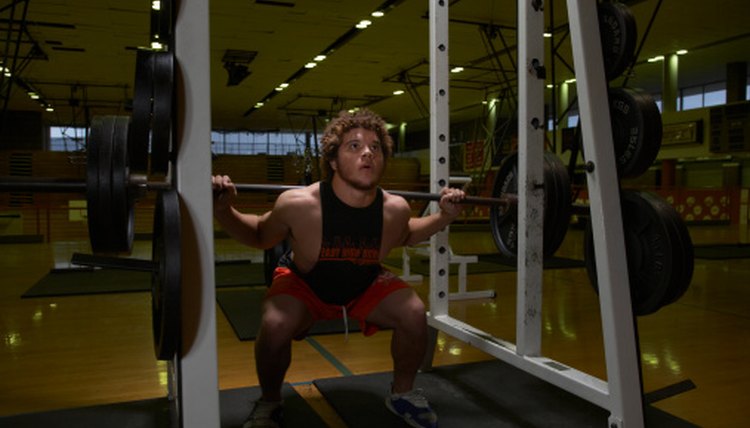
The Bowflex home gym system provides a complete body workout. Many of the Bowflex systems are available with squat straps so you can strengthen your lower body with this multi-joint movement. Bowflex recommends wearing non-slip shoes when you perform a squat so you reduce your risk of injury from your feet slipping out from under you.
Remove the bench from your Bowflex. Lift up on the long portion of the bench and pull it away from the smaller seat.
Slide the seat to the position closest to the tower. Pull out the seat rail knob. Slide the seat toward the tower and then release the knob into the locking hole.
Fasten the lower end of each squat strap to the squat cable on the sides of the bench bar. Push on the straight bar of a snap hook and slide the cable and the squat strap's "D" ring into the hook. Release the bar of the hook so it locks in place.
Fasten the squat straps to the squat bar using snap hooks. Press the straight part of the hook to open it. Slide the "D" ring of the squat bar and the squat strap into the hooks. Release the straight bar of the hook to lock it in place.
Adjust the height of the squat strap. Straddle the bench bar and place the squat bar across your upper back. Bend your knees to the lowest angle of your squat, but do not exceed a 90-degree bend in your knees. Lengthen or shorten the squat straps so the power rods have only a slight bend in them at this point.
Tips
Squats are strength-training exercises that cause a breakdown in muscle tissue, so allow for one day of rest in between your lower body workouts for muscle repair.
References
- Wirtz N, Zinner C, Doermann U, Kleinoeder H, Mester J. Effects of loaded squat exercise with and without application of superimposed EMS on physical performance. J Sports Sci Med. 2016;15(1):26–33. Published 2016 Feb 23.
- Jeon YK, Shin MJ, Kim CM, et al. Effect of Squat Exercises on Lung Function in Elderly Women with Sarcopenia. J Clin Med. 2018;7(7):167. Published 2018 Jul 5. doi:10.3390/jcm7070167
- Gullett JC, Tillman MD, Gutierrez GM, Chow JW. A biomechanical comparison of back and front squats in healthy trained individuals. J Strength Cond Res. 2009;23(1):284-92. doi:10.1519/JSC.0b013e31818546bb
- Cotter JA, Chaudhari AM, Jamison ST, Devor ST. Knee joint kinetics in relation to commonly prescribed squat loads and depths. J Strength Cond Res. 2013;27(7):1765–1774. doi:10.1519/JSC.0b013e3182773319
- Watanabe S, Takahashi T, Takeba J, Miura H. Factors associated with the prevalence of back pain and work absence in shipyard workers. BMC Musculoskelet Disord. 2018;19(1):12. Published 2018 Jan 11. doi:10.1186/s12891-018-1931-z
- van Vledder N, Louw Q. The effect of a workstation chair and computer screen height adjustment on neck and upper back musculoskeletal pain and sitting comfort in office workers. S Afr J Physiother. 2015;71(1):279. Published 2015 Nov 10. doi:10.4102/sajp.v71i1.279
Tips
- Squats are strength-training exercises that cause a breakdown in muscle tissue, so allow for one day of rest in between your lower body workouts for muscle repair.
Writer Bio
A mother of two and passionate fitness presenter, Lisa M. Wolfe had her first fitness article published in 2001. She is the author of six fitness books and holds an Associate of Arts in exercise science from Oakland Community College. When not writing, Wolfe is hula-hooping, kayaking, walking or cycling.