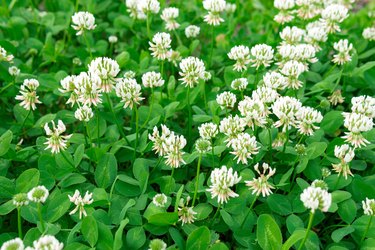
Clovers such as white clover (Trifolium repens, USDA hardiness zones 3-10) and other species in this same genus infest lawns year-round, but fertilizing regularly, removing clover plants or spraying with a selective broad-leaved weed herbicide provide control without harming the grass. Another option is to learn to live with these beneficial weeds.
How to Identify Clover
Video of the Day
White clover is one of the most common lawn weeds. The genus name, Trifolium, refers to the three-leaf clusters around the plant stems, and white clover also bears globe-shaped white spring flowers. White clover grows 3 to 6 inches tall and 12 to 18 inches wide.
Video of the Day
Fertilize Your Lawn to Eliminate Clover
Clovers are nitrogen-fixing plants, which means they take nitrogen from the air, and microorganisms in their special root nodules convert it into a form plants can use. Nitrogen is an essential plant nutrient. Their nitrogen-fixing ability helps clovers grow in low-fertility lawns, where they out-compete nitrogen-hungry grass. Fertilizing lawns encourages grass to grow strongly and become the dominant plant once more.
Most lawn grasses benefit from no more than 1 pound of actual nitrogen per 1,000 square feet four times per year when the grass is actively growing. The first application is in spring when grass growth starts up, and the last application is in fall before growth stops. The other two applications are evenly spaced between the first and last. Water the lawn after applying fertilizer.
Note that some grass types grow best when they receive less than 1 pound of fertilizer per 1,000 square feet of grass. Check with your local cooperative extension service if you're unsure how much fertilizer to apply or when to apply it.
How to Remove Clover
Small patches of clover can be removed with a trowel or weeding tool. Clover clumps spread widely but their root systems are narrow. If you dig up plants when they're small and remove the whole root system, you can prevent clover from taking over a lawn. Here's how:
- Lift up the clover stems to find the plant's crown, where it joins its roots.
- Gather the stems in one hand to expose the base of the plant, and push a trowel vertically into the soil at the plant's base. Lever the trowel upward to lift the roots out of the soil.
- Check the lawn every week during the growing season for new clover plants, and remove them.
- When large amounts of clover have been removed, you can sprinkle grass seed over the bare patches of soil where you removed the clover plants.
- Water the seed regularly to encourage the grass to grow well.
Spray Clover with Herbicides
Clovers are broad-leaved weeds, and herbicides that control these plants rarely harm grass. Quinclorac, animocyclopyrachlor, fluroxypyr and triclopyr are some chemicals in broad-leaved weed herbicides that control clovers well.
The best time for applying a broad-leaved weed herbicide containing 4.85 percent 2,4-D, 1.61 percent quinclorac and 0.45 percent dicamba is when the weeds are small and actively grown. Put on long pants, a long-sleeved shirt, shoes, socks, safety goggles and gloves, and evenly apply the herbicide on a still, dry day when temperatures are less than 85 degrees Fahrenheit. If the lawn is dry, irrigate it one or two days before applying the herbicide, and don't mow the lawn for one or two days afterward.
Evenly spraying your entire lawn helps to control well-integrated clover, but localized application involves targeting only the areas with patches of clover. Try localized application of a selective broad-leaved weed killer first, and then move to generalized application of the herbicide if stragglers remain throughout the lawn.
Use caution when spaying broad-leaved herbicides near garden plants, as they may cause damage. Don't spray the herbicide near plants you wish to keep, or protect them with cardboard before spraying.
Living With Clover
Clovers improve soil fertility and structure and attract beneficial insects, such as bees. The low-maintenance option to lawns infested with clovers is to learn to live with the plants. Clover roots increase nitrogen levels in the soil, and the long taproots reach down into the subsoil, where they take up minerals and bring them into the upper soil layer. Clover roots also help break up compacted soil.
Clover flowers provide nectar for bees, which pollinate other flowers in the garden and many essential crops. Many consider clover flowers and leaves attractive, and some lawn grass seed mixtures include clovers.