
High School Softball Rules & Regulations
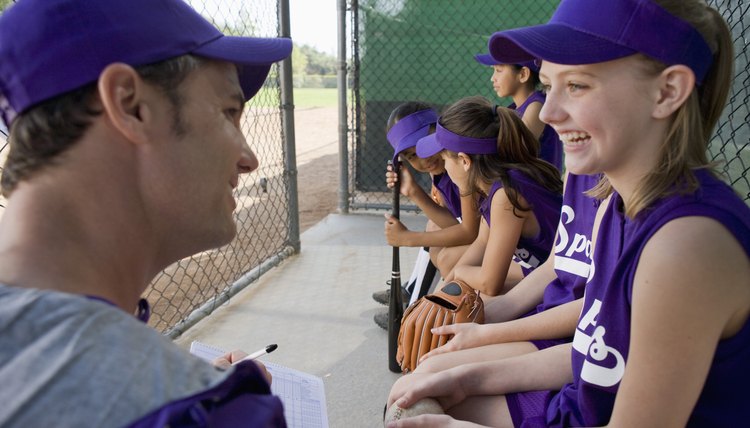
Fast-pitch softball is the fifth most popular girls high school sport, according to the National Federation of State High School Associations. A total of 362,488 girls played high school softball in the 2012-13 school year. Fast-pitch softball is played in the spring and is basically the girls’ alternative to baseball at the high school level. Each state can set its own rules, but most typically apply the standard NFHS rules.
Take the Field
The bases are 60 feet apart on a fast-pitch softball diamond. The distance from the rear tip of home plate to the front edge of the pitcher’s rubber is 43 feet. The outfield fence typically ranges between 185 and 235 feet from home plate. Otherwise, there are no major differences between high school baseball and softball fields.
Use the Right Equipment
The biggest difference between baseball and softball is, of course, the larger ball used in softball. The high school fast-pitch softball is 12 inches in circumference and weighs between 6 1/4 and 7 ounces. Players typically use metal bats which must meet Amateur Softball Association of America standards. Each bat must include a knob at the end of the handle, a safety grip measuring 10 to 15 inches and a round, smooth barrel. Batters and runners must wear helmets at all times.
Players and Substitutions
Unlike slow-pitch softball -- which typically features 10 defensive players -- fast-pitch teams use nine players in the field. Teams may use a designated player to bat for any specified player in the lineup. Any player may be removed from the game and then return once, provided she bats in the same position in the lineup throughout the game. A team may use a courtesy runner any time its pitcher or catcher reaches base. In such cases, neither the pitcher nor the catcher is considered to have left the game.
Playing the Game
A standard high school softball game lasts seven innings. A game that ends early -- because of poor weather, for example -- will count if the losing team has batted at least five times. The NFHS does not enforce a mercy rule, but individual states typically call for a game to end early if one team builds a sufficiently large lead. In Alaska, for example, a game ends with a team leads by 15 runs after three innings, 12 runs after four innings or eight runs at the end of five innings.
Batter Up
As in standard baseball, batters draw walks by taking four balls and strike out on three strikes. Pitchers may intentionally walk a hitter by request, without throwing any pitches. A player with two strikes who bunts the ball foul has struck out. Unlike slow-pitch softball, runners may leave bases and attempt to steal when the pitcher releases the ball.
On the Mound
Pitching mechanics are more closely regulated in fast-pitch softball than standard baseball. As in baseball, the pitcher must begin with her pivot foot on the rubber. Additionally, the fast-pitcher hurler must stand with her shoulders square to the plate and her hands separated, then she must bring her hands together in front of her body before starting her windup. The ball must be thrown underhand, using no more than 1 1/2 revolutions of her arm. At the release point, a pitcher’s hand must be lower than her hip and her wrist may not be farther from her body than is her elbow.
Writer Bio
M.L. Rose has worked as a print and online journalist for more than 20 years. He has contributed to a variety of national and local publications, specializing in sports writing. Rose holds a B.A. in communications.