
It can be difficult to figure out how fast wind is blowing by only focusing on the wind itself. Using an instrument such as an anemometer can give you a more precise answer on how fast the wind is moving. But many times you might not have those devices available to you when you want to know how fast the wind blows.
Wind Speed From Flag
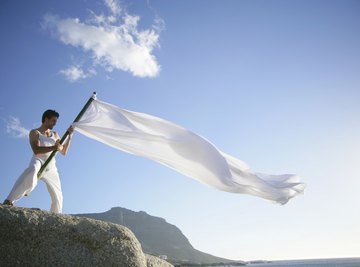
When you find a flag blowing in the wind, estimate the angle between the flag and the flag pole. Divide this angle by four to get the wind speed in mph. A flag that's at an 80-degree angle would have a speed of approximately 20 mph.
You can also estimate the wind speed using the general nature of the flag itself. If the flag is barely moving, the wind speed is likely below 3 mph. Light flags extend out at about 8 to 12 mph. A heavy flag that waves over the entirety of its own length has a wind speed of 19 to 24 mph. Starting at wind speeds of about 25 mph and over, flags extend out fully.
Wind Barbs
Wind barbs are wind-speed flag symbols that correspond to differences in how fast the wind is blowing. These symbols represent how the flag is moving in a way that you can estimate the wind speed from it. Wind barbs are made of a staff and feathers or flags. The staff shows the direction, and the end of the wind barb that has a flag shows the direction the wind is coming from.
The feathers on the staff tell you wind speed to the nearest 5 segments of knots, a unit for wind speed. 1 knot is about 1.9 km/hr or 1.15 mph. The National Weather Services provides helpful conversions between mph and knots for wind speed.
Short feathers mean 5 knots, long feathers are 10 knots and a pennant or flag represents 50 knots. Sum up these feathers to figure out the wind speed in knots.
Scientists and engineers can create maps of wind barbs that show different barbs for different locations across an xy-coordinate system to give an overview of wind speeds across bodies of water. This comes in handy for practical applications like sailing and shipping.
Uses of Wind Power
Wind-generated sources of electricity such as windmills and turbines use generators. These generators create an electromagnetic force when wind moves them. A wind-based generator pumps to produce electrical power that can power cities and buildings.
Shipping companies are beginning to embrace wind-based transportation to reduce their dependence on fuel. In reducing their carbon footprint, boats and ships can use local and regional winds to drive their movement. In these cases, the mast and sail function in ways similar to a flag. Their potential to use the power of the wind makes them ideal candidates of figuring out wind speed from the movement of a mast and sail.
Sports take advantage of wind as well. Windsurfing and sailing involve people racing against one another, using the wind to power their boats or surfboards. In these activities, people can figure out how fast they will move based on how the wind feels or how the wind affects their boats.
Kitesurfing and kiteboarding also let people harness the power of wind in their activities and pastimes. Any way the wind blows, knowing how wind affects the movement of kites and boards can let you make quick, easy calculations on wind speed.
References
Resources
Tips
- The maximum wind speed you can estimate by using a single flag and the army's technique is 22.5 miles per hour (36 kilometers per hour). You can make more accurate estimations by deploying several flags on the same pole, each of a different weight.
About the Author
S. Hussain Ather is a Master's student in Science Communications the University of California, Santa Cruz. After studying physics and philosophy as an undergraduate at Indiana University-Bloomington, he worked as a scientist at the National Institutes of Health for two years. He primarily performs research in and write about neuroscience and philosophy, however, his interests span ethics, policy, and other areas relevant to science.
Photo Credits
Goodshoot/Goodshoot/Getty Images