
How to Make a Backyard Baseball Field
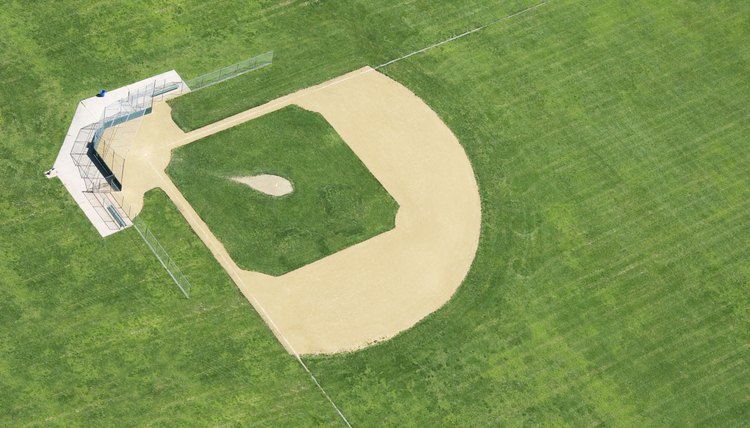
Professional baseball operates five levels of the minor leagues. Major League hopefuls must validate themselves at every level before getting to "The Show," proving just how difficult the game of baseball is to play. Experts claim it takes 10,000 hours of game play to master America's pastime. You, your friends and family can build those hours of mastery with access to a backyard baseball field.
Space It Out
You need some serious space, so your backyard must be massive. An average full-size baseball field measures 330 feet down the foul lines from home plate to the home run fence, and 400 feet to center. And that's just fair territory. You'll also need foul territory behind home plate and down the foul lines. Taking first things first, lay down home plate. Get out into your yard and position the plate with at least 15 feet of foul territory behind the base. Get a friend and a 400-foot tape measure and walk out the dimensions to see if you have enough room. Use the rear slanted edges of the plate to start the foul lines for your measurement.
Level the Playing Field
Ballplayers aren't looking down at the ground during play. They are looking for the ball or the base as they sprint at full speed. To avoid injury, you'll need to level your land. Use a machete and riding mower to get rid of any tough grass, or rent a brushing mower, and then fill in any hollows. Use a half-moon spade to cut a cross of turf over the hollow. Peel back the flaps, fill the hollow with high-quality top dressing, then carefully lay the turf back down. Tamp the cuts with the back of a rake and water the hollow.
Mark the Bases
Drive a screwdriver into the ground at the apex of home plate and tie a string around it. Walk down each foul line measuring the string at 90 feet to mark the back edges of first and third. Drive two more screwdrivers into the ground at the 90-foot marks, tying two more lengths of string to the screwdrivers. Have friends walk the strings out toward second base, meeting where they both measure 90 feet. Walk home plate's string out to where your partners have met at second base, measuring the string to 127 feet 3.75 inches. The center of second base will go where all three strings meet. Mark the front of the pitching rubber using home plate's outstretched string at 60 feet 6 inches.
Cut the Infield
Get a partner to hold down the end of a tape measure in the middle of the plate. Pinch the tape measure at 26 feet and walk around the plate while marking the grass with a can of spray paint. Use your half-moon spade to dig up the grass inside the circle and fill with high-quality dirt or clay. Do the same for each base, measuring, spraying and cutting at the 13-foot mark. The infield arc is marked using the pitching rubber as the center of the circle, measured and cut at the 95-foot mark. Cut the turf using straight lines between the bases. The running lanes from home to first and from third to home are optional; some baseball fields don't have them. But you can cut them 5 to 8 feet wide.
Build the Mound
Measure 2 feet toward home plate from the center of the rubber. Use that as your anchor point and cut an 18-foot circle for the mound. Use 3 to 4 cubic yards of soil to build up the mound. The rubber stands 10.5 inches off the ground with a slope of 1 inch down per lateral foot out toward home plate. The slope begins 1 foot in front of the rubber. Build the mound up from the ground, going 1 inch of soil at a time. Once your mound is built, you can choose to build a home run fence, or not. You'll also have to worry about foul balls. A 15- to 20-foot backstop might protect your house, but you're better off buying a batting practice turtle shell to stop all fouls. And use your screwdrivers, string and spray paint to mark foul lines.
References
- Turffiles.ncsu.edu: Baseball Field Layout and Construction
- HGTV.com: How to Create a Level Lawn
- OnDeckSports.com: Backstops & Batting Practice Cages
- Outliers: the Story of Success; Malcolm Gladwell; June 7, 2011
Writer Bio
Christopher Michael began writing in 2010 for Break.com. He received a Bachelor of Arts in English from the University of Massachusetts, Amherst. Writing sports and travel articles helps support his professional baseball career, which has taken him to 49 states, five continents and four oceans.