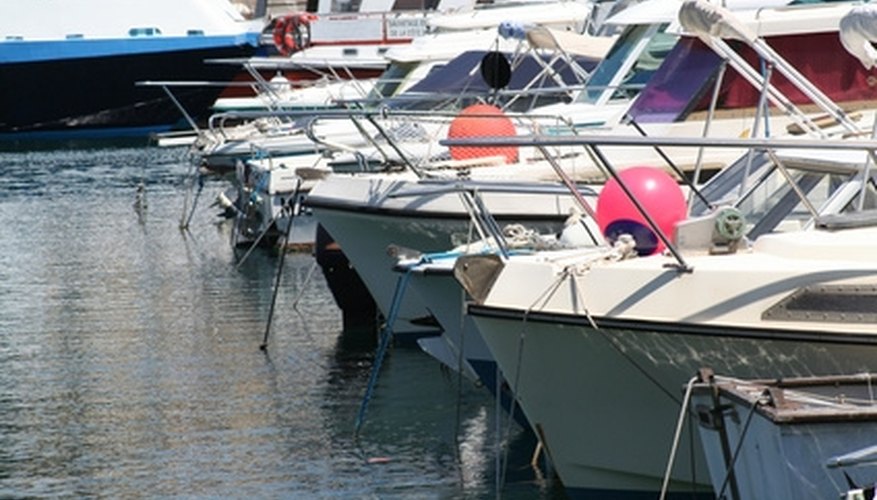


There are several reasons why a boat owner might want to drain a boat's fuel tank. Perhaps the fuel has been contaminated by water or another substance. An owner might prefer to remove fuel from the tank for the winter rather than treat the fuel. Whatever the reason, removing fuel from a boat fuel tank is something that almost any boater can accomplish with a few tools purchased at any marina store.
Items you will need
Work gloves
Eye protection
3/8-inch fuel hose
Primer bulb
Two hose clamps
Screwdriver
Run the boat so most of the fuel has been used. Stop when there is about an eighth of a tank of fuel left so as not to run out of fuel on the water.
Put on work gloves and eye protection. Place the boat on a trailer and remove the boat from the water. Drive the trailer to a level location.
Place a 3-foot length of 3/8-inch fuel hose on one end of a primer bulb. Slide a clamp over the hose until the clamp is close to the bulb. Tighten the clamp with a screwdriver. Place the other 3-foot length of hose on the other end of the primer bulb. Slide on the remaining clamp and tighten with the screwdriver in the same manner.
Remove the fuel cap from the fuel tank. Place the suction end of the 3/8-inch fuel hose into the fuel tank until it contacts the fuel. Place the other end of the 3/8-inch fuel hose into an improved fuel receptacle.
Squeeze the primer bulb to move fuel from the boat fuel tank to the fuel receptacle. Continue squeezing the bulb until all the fuel has been removed.
Place the cap back on the boat fuel tank. Drive the trailer to the parking space for the boat. Remove work gloves and eye protection.
Warnings
- Never perform any work near fuel tanks when there is a chance of a flame or a spark anywhere near the area.
- Always wear work gloves and eye protection when working with or around fuel.
Tips
- If possible, tip the fuel tank to force fuel to one corner, making it easier to remove all the fuel in the tank. If the tank is permanently mounted in the boat, move the trailer to a slightly angled location to force the fuel to one corner.
References
Tips
- If possible, tip the fuel tank to force fuel to one corner, making it easier to remove all the fuel in the tank. If the tank is permanently mounted in the boat, move the trailer to a slightly angled location to force the fuel to one corner.
Warnings
- Never perform any work near fuel tanks when there is a chance of a flame or a spark anywhere near the area.
- Always wear work gloves and eye protection when working with or around fuel.
Writer Bio
This article was written by the CareerTrend team, copy edited and fact checked through a multi-point auditing system, in efforts to ensure our readers only receive the best information. To submit your questions or ideas, or to simply learn more about CareerTrend, contact us [here](http://careertrend.com/about-us).