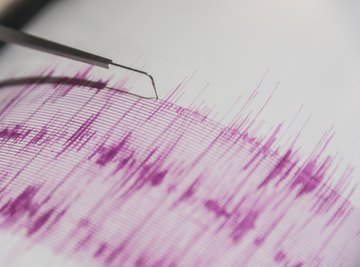
The epicenter is the point on the Earth’s surface immediately above the center of underground movement sensed as an earthquake. This movement sends out shock waves of many kinds, which move at different speeds. The different waves can be detected by sensitive instruments called seismographs.
From the time difference between the first recorded occurrence of different kinds of waves of the same earthquake, a scientist studying the seismograph record can determine the distance to the earthquake’s epicenter but cannot determine the direction. By using three or more seismographs, however, a scientist can triangulate a location.
- Seismograms from three different seismograph stations
- World map
- Compass for making circles
A seismograph is an instrument that measures ground movement continuously. A seismogram is the record, usually on paper, that a seismograph produces. In real life, scientists use many more than three seismograph records to locate an earthquake's epicenter.
Measure the difference in arrival times between the first shear (s) wave and the first compressional (p) wave, which can be interpreted from the seismogram. Multiply the difference by 8.4 to estimate the distance, in kilometers, from the seismograph station to the epicenter.
Open the compass until the gap equals the calculated distance to the epicenter. Draw a circle on a world map, centered on the location of the first station. The epicenter can lie anywhere on this circle.
Repeat the calculation process for the distance from the second seismograph station, and draw a circle of the calculated radius on the map, centered on that station. This circle and the first will intersect at two points. The epicenter can be at either point.
Repeat the calculation and drawing process for the third seismograph station. The three circles will meet at a common point, which is the epicenter.
Things You'll Need
Tips
Resources
Tips
- A seismograph is an instrument that measures ground movement continuously. A seismogram is the record, usually on paper, that a seismograph produces.
- In real life, scientists use many more than three seismograph records to locate an earthquake's epicenter.
About the Author
Kelvin O'Donahue has been writing since 1979, with work published in the "Arizona Geological Society Digest" and "Bulletin of the American Association of Petroleum Geologists," as well as online. O'Donahue holds a Master of Science in geology from the University of Arizona, and has worked in the oil industry since 1982.