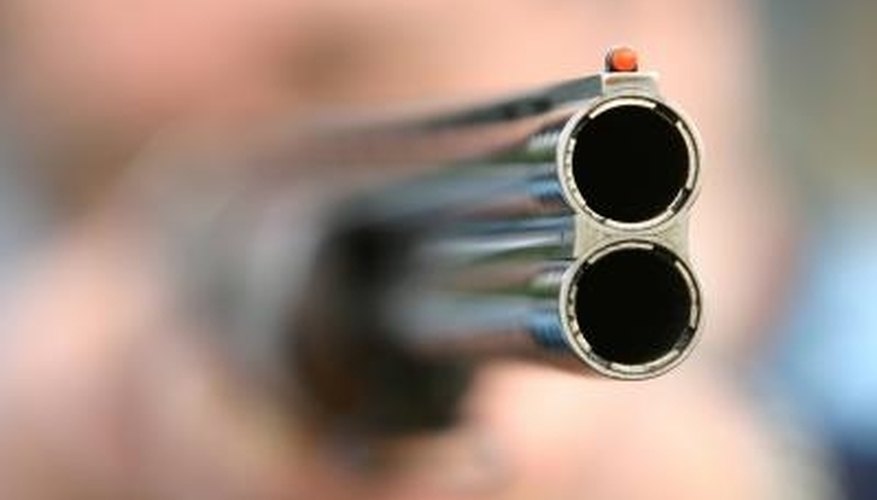


The importance of choosing the right shotgun choke for the job is one of the most under-appreciated aspects of shotgun shooting. Good choke selection can make or break a hunting trip or competition. The term "choke" refers to a constriction at the end of a shotgun barrel that determines the density of the shot pattern; the tighter the choke, the more dense the pattern and the longer the range. Regardless of the gauge of your shotgun, the types of chokes used will be the same.
Full Choke
The full choke is the tightest of the standard shotgun chokes, meaning that it results in the most dense pattern of shot. As such, full choke is mostly used for long-range shooting (40 or more yards), where the denser pattern keeps the shot column together longer. At close ranges, the full choke will not only make it harder to hit your target (due to the smaller shot spread), but it will greatly increase the risk of spoiling the meat, fur or feathers of your intended quarry.
Modified Choke
This is possibly the most versatile and robust of shotgun chokes. It is most useful for mid-range upland game, such as pheasant, quail and dove. The modified choke has an effective range of just over 30 yards. There are also slight variations of the Modified Choke called the Improved Modified and Light Modified chokes, which give small increases in range or spread, respectively.
Improved Cylinder Choke
The Improved Cylinder is the widest choke practical for hunting purposes. It has an effective range of 25 yards and is primarily useful for close-range hunting. The Improved Cylinder Choke mainly comes into its own early in the hunting season, when game is still feeling comfortable and is not yet skittish. Past the first week or two of the hunting season, however, hunters should switch to something with a denser pattern, such as the Modified Choke.
Skeet Choke
The Skeet Choke is slightly wider than the Improved Cylinder Choke and has an effective range of just over 20 yards. The Skeet Choke is primarily used for competitive and recreational skeet shooting, and is generally considered to be too wide for hunting purposes. The wider spread of the Skeet Choke makes it easier to hit targets that do not require large pellet volume to shatter, such as clay pigeons.
Cylinder Bore
The Cylinder Bore (sometimes called a Cylinder Choke) refers to the shotgun barrel when used without any choke to tighten the pattern. This gives the widest pattern and thus the least shot pattern density. The Cylinder Bore has an effective range of less than 20 yards, which makes it impractical for most hunting purposes. Shotguns with Cylinder Bores are most commonly used in civilian and law enforcement applications, where the wide shot pattern at close range is considered an asset.
References
Writer Bio
As a business analyst, columnist and blogger, Richard Rohlin has had a variety of experience in different kinds of writing since 2007. Rohlin is published regularly in the "Fort Worth Examiner," where he writes informative articles on local hunting and shooting sports. Rohlin holds a B.A. in history and English from Thomas Edison State College in New Jersey.