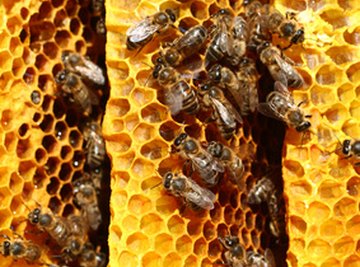

Bees collect propolis from tree buds and plants to use as a sealant for small gaps in the bee hive. Propolis is a dark brown resin that is quite sticky and tends to stain clothing and other materials with which it comes in contact. Many beekeepers collect propolis from the hives to sell commercially because it has proven health benefits, most notably as a natural antibiotic and immune system supporter. Beekeepers will suffer clothing stains that seem impossible to remove. However, there are methods to remove the propolis stains from clothing.
- Scraper
- Cloth
- Small knife
- Hot water
- Charlie's Laundry Soap or other laundry soap
- Charlie's All Purpose Cleaner or other cleaner
- Washing machine
Use the scraper to remove as much propolis as possible. Use a damp cloth to remove the propolis resin from the scraper and, if needed, a small knife to assist.
Soak the cloth in hot water for 20 minutes. Remove and re-scrape it. More propolis should be removed at this time.
Create a paste using the dry laundry powder and the liquid all-purpose cleaner. The ratio should be 3-to-1. Apply the paste to the propolis-stained cloth and rub into the material. Soak it in hot water for 20 minutes.
Rinse the cloth in hot water to remove the paste and additional propolis. Reapply the paste and let it sit for one hour. Do not soak it.
Wash the clothes in hot water and spray with additional all-purpose cleaner. Add laundry detergent to the wash. Remove it after washing. The propolis stain should be gone.
Things You'll Need
References
About the Author
Kate Muir began her career in 2000 and has written corporate communications, largely in the field of arts and cultural policy. Her articles have been published in the "Toronto Star." Muir has a Bachelor of Arts, Honors, in political science and cultural policy.
Photo Credits
rayons image by Claudio Calcagno from Fotolia.com