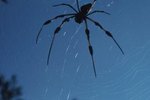
Spiders make their webs by producing and arranging silk strands, produced by tiny organs on their abdomens. Called spinnerets, these tiny organs release the silk in liquid form, but it quickly becomes solid after contacting the air. Relatively few pet species spin elaborate webs, but most use silk for other purposes, such as constructing tripwires that notify the spider when predators or prey are close.
Different Types of Silk
Spiders produce several types of silk, each of which serves a different purpose. Some silks are wet, while others are dry; some bear numerous bumps, while others are completely smooth. These types of silk help the spiders to meet different needs. For example, webs designed for catching prey feature sticky threads that snare prey, as well as nonsticky threads that the spiders use for traveling around the web.
Layout and Design
Spiders that build large, spanning webs, as orb weavers do, begin building their webs by releasing a long strand of silk. Once it catches onto a tree, bush or rock, the spider tightens the thread, thereby forming the first segment -- called the bridge line. The spider can then travel back and forth across this segment, attaching additional strands to it. After producing the bulk of the web, the spider lays a sticky strand in a spiral pattern across the center of the web, which serves to capture prey.
Other spiders build differently shaped webs, taking the form of sheets or funnels. As silk pours from the spinnerets, spiders manipulate it with their legs. According to “The Naked Scientists,” a spider’s genetic code determines how the legs move, thereby influencing the ultimate design of the web.
The “Why” of Webs
Spiders make webs for a variety of purposes, including prey capture, defense and shelter. For example, pink toe tarantulas (Avicularia avicularia) often deposit silk in and around the hiding spots in their cage. Many trapdoor spiders line their burrows with silk and use silk to help make the hinge for their trap doors.
Other species spin large webs in hopes of entangling prey that bumps into it. After the prey bumps into the web, the spider typically runs over to it, injects it with venom and then wraps it in silk to immobilize it while the venom takes effect.
Some spiders -- particularly young individuals -- use silk for dispersal. Called ballooning, the technique involves releasing a long strand of silk, which is lifted into the air by the wind. As the silk begins flowing in the air currents, the spider is pulled along for the ride.
Silk is often involved with the reproductive process as well. Many male tarantulas, for example, deposit their sperm on silken webs as part of the mating ritual.