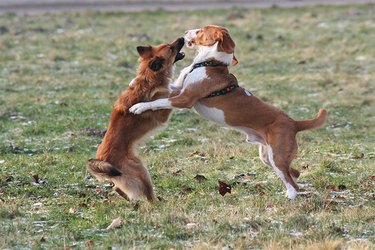
Fewer incidents involving two dogs that share a home are scarier (and more emotionally taxing) than an all-out, snapping, snarling, seemingly unstoppable dog fight. The fight itself is terrible enough, but what do you do afterwards? Keep your cool, and follow the steps below.
1 - Once the fight is over and the two dogs have been separated, take a deep breath. It's important you stay relaxed so you can convey calmness and strength to your dogs. Your critters will feed off your emotions, so before you do anything, take a deep breath.
Video of the Day
Video of the Day
2- Go to the dog most likely to have been injured. Typically, this is the youngest, smallest or newest dog. Thoroughly examine your pup for injuries, ensuring you check inside your dog's mouth as well as each leg, chest, belly and groin. If your dog has longer fur, carefully look through his hair while being watchful for any sensitivity to touch or for signs of pain.
3 - Use a clean rag or towel to staunch any bleeding. Do not give your dog any medication or attempt to treat the wounds. Once the bleeding has stopped, place the first dog back in his crate or secure area.
4 - Check the second dog for injuries the same way you did the first. Stop the bleeding, if present. Place the second dog back in his crate or secure area.
5 - If there are injuries, call your vet immediately. Wounds from a dog fight can often damage tissue far deeper than the human eye can see and your dog will likely need antibiotics to prevent infection.
6 - After both dogs are medically cleared, keep them separated for 36 to 48 hours. Allow them both time to calm down, cool off and return to their normal selves. Walk them separately, feed them separately and spend time with them separately.
7 - Take the dogs to a safe, neutral location such as a local park. Bring a human helper. Place a collar and leash on each dog, and have your human helper take one of the dogs.
8 - Start to walk down a path with one of the dogs. After you're 10 or 15 steps ahead, have your human helper start to walk down the same path, behind you. Gradually allow your human helper to close the distance until she or he is walking beside you. If you notice signs of aggression from either dog, increase the distance again.
9 - Continue walking until both dogs will walk beside one another. Once they're walking beside each other, allow the helper to fall behind again. When you're 20 to 25 steps ahead, turn and walk back towards the helper, approaching them directly. Simply pass your helper; don't allow the dogs to stop and interact. Repeat 2 or 3 times.
10 - Once your dogs are comfortable passing each other, stop and allow them to interact a bit. By this point, they should be quite re-acquainted. If there is no aggression, pack up the dogs and head home.
11 - Allow the dogs to interact in the yard, on-leash, with your human helper close at hand to help break up the dogs if necessary. Keep a close eye on them and don't leave them unsupervised.
12 - Until you're comfortable trusting them again, only allow the dogs to interact when you're close enough to intervene. If you're not able to supervise them directly, crate one or the other. Do not leave them alone together.
Warning: Never reach into a dogfight to break it up. Canine behavior can be unpredictable and you may need to contact a professional for assistance.
By Kea Grace
References
Healthy Pet: Reasons Dogs Fight
Your Dog's Friend: Aggression Between Family Dogs
The Canine Behavior Series: Fight Dogs
Terrierman's Daily Dose: Knowing What NOT to Do in a Dog Fight
About the Author
Since 2001, Kea Grace has published in "Dog Fancy," "Clean Run," "Front and Finish" and an international Czechoslovakian agility enthusiast magazine. Grace is the head trainer for Gimme Grace Dog Training and holds her CPDT-KA and CTDI certifications. She is a member of the APDT and is a recognized CLASS instructor. She's seeking German certification from the Goethe Institut.