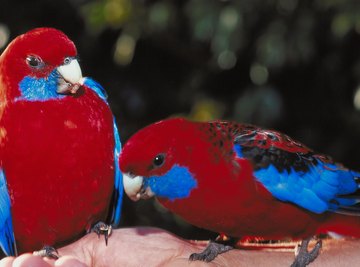
Rosellas are one type of many colorful varieties of parrots in the world. In fact, there are around 350 species in the parrot order, Psittaciformes, across the globe - six of these parrot species are rosellas. These small types of parrots belong to the genus Platycercus. Rosellas are omnivores, primarily foraging for nectar, seeds, fruit, flower buds and some invertebrates throughout the year.
Rosella Types
There are six different rosella species found across Australia. They are the Crimson Rosella (Platycercus elegans) and Eastern Rosella (P. eximius), whose range is across southeastern Queensland to South Australia's Flinders Range. Eastern Rosellas were also introduced to New Zealand in the early 1900s and today can be sighted in the wild across the North Island. Along the east coast of Queensland and northern New South Wales, you will find the Pale-headed Rosella (P. adscitus).
Green Rosellas (P. caledonicus ) are only found in Tasmania. Western Rosellas (P. icterotis) are found only in the far western areas of Western Australia. And of course, the most northern-ranging rosellas found across the Northern Territory to the Northern Kimberly are the Northern Rosellas (P. venustus).
Cheek Patch Identification
As some rosellas' geographic ranges overlap, looking at the color of their cheek patches is a great clue to help tell each species apart. Western Rosellas have yellow cheeks. The Green, Crimson and Yellow Rosellas have blue cheeks. Last but not least: Eastern, Pale-headed and Northern Rosellas have white cheek patches.
Rosella Food
A big portion of a rosella's diet is the nectar from flowers. However, rosellas also eat plants, leaves, shoots, grasses, fruits, seeds and buds. The Australian native plants they commonly feed on include wattles (Acacia spp.), Eucalyptus spp., Callistemon spp., Banksia spp., Grevillea spp., and Melaleuca spp. When they're not feeding in the trees or on shrubs, rosellas are commonly seen feeding on the ground in open fields, including golf courses, pastures, paddocks and roadsides.
Rosellas may also be seen ripping off tree bark to get to hiding invertebrates. From October to January, rosellas eat more invertebrates during the breeding season than during the rest of the year. This is because invertebrates are a food source rich in protein. Nesting adult rosellas feed their young this protein-rich diet to help them grow.
Flocks of Rosellas
In winter, small flocks of subadults, juveniles and some adults forage for food together. During the breeding season, aggressive behaviors increase as they try to find a mate to pair with. Once flocks disband, birds are seen foraging alone or in their pair on the ground in open areas. In addition, rosella flocks are often sighted foraging among other types of parrots, such as parakeets.
Eastern Rosellas tend to have flock sizes between eight and 30 birds. Crimson Rosellas form flocks of five or six juveniles and subadults on average. However, up to 100 birds in a single flock have been recorded.
Attracting Rosellas Into the Garden
Rosellas are great to have around the garden as they eat unwanted insects and pollinate flowers. Planting rosellas' favorite native Australian trees is a great way to help attract these colorful parrots to the garden. Having big trees around also gives them the perfect place to perch for a rest when the sun is hot.
Rosellas are cavity nesters. This means that they build their nests in holes of trees, so keeping those old trees around could help attract a rosella family into the garden. Sometimes they can be encouraged to use nest boxes or other artificial nesting sites.
Pet Rosellas
Rosellas are intelligent pets with a long lifespan of 20 to 27 years. Eastern Rosellas are the most common species in the pet trade. To help mimic their rich wild diet, according to Pet Guide, rosellas should be fed a small birdseed mix containing oats, canary and sunflower seeds alongside a wide variety of fruit and fresh untreated branches with leaves and shoots for them to chew on.
References
- New Zealand Birds Online: Eastern Rosella
- Smithsonian Magazine: 14 Fun Facts About Parrots
- Backyard Buddies: Rosellas
- Australia Museum: Crimson Rosella
- The Science of Nature: Insectivorous Birds Consume an Estimated 400–500 Million Tons of Prey Annually
- New Zealand Birds Online: Crimson Rosella
- BirdLife Australia: Western Rosella
- Australia Museum: Eastern Rosella
Resources
About the Author
Adrianne Elizabeth is a freelance writer and editor. She has a Bachelor of Science in Ecology and Biodiversity, and Marine Biology from Victoria University of Wellington in New Zealand. Driven by her love and fascination with all animals behavior and care, she also gained a Certificate in Captive Wild Animal Management from UNITEC in Auckland, New Zealand, with work experience at Wellington Zoo. Before becoming a freelance writer, Adrianne worked for many years as a Marine Aquaculture Research Technician with Plant & Food Research in New Zealand. Now Adrianne's freelance writing career focuses on helping people achieve happier, healthier lives by using scientifically proven health and wellness techniques. Adrianne is also focused on helping people better understand ecosystem functions, their importance, and how we can each help to look after them.
Photo Credits
Jupiterimages/Photos.com/Getty Images