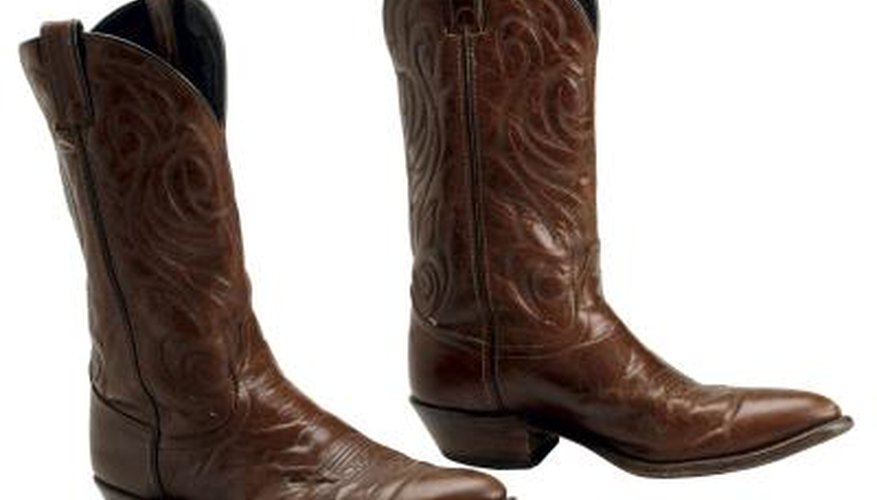



Like any pair of shoes, a good pair of cowboy boots can be hard to find. Finding a pair of boots that fits your foot perfectly can be impossible. Whether you are working in your boots or using them as your everyday footwear, the last thing you want is for them to be uncomfortable. Fortunately, sore feet and blisters can be avoided with a reliable technique for shrinking boots. Simply buy a pair of cowboy boots that are a bit too big for your feet, and this technique will shrink and mold them to your feet.
Items you will need
Bucket
Socks
Soaking the Boots
Step 1
Fill a bucket or basin with enough water to submerge the boots. If need be, you can fill up your bathtub.
Step 2
Submerge the boots in the water, making sure that both boots are completely covered by the water.
Step 3
Leave the boots submerged for at least an hour before removing them from the water. You want to make sure that the boots are completely saturated.
Soaking Your Socks
Step 1
Take a pair of your socks and soak them in water.
Step 2
Let your socks soak for about five minutes.
Step 3
Remove your socks from the water.
Shrinking the Boots
Step 1
Wearing your wet socks, insert your feet into the wet boots.
Step 2
Wear the boots until your socks dry without taking them off. This usually takes about a day.
Step 3
Go about your day-to-day activities in the boots to make sure the boots experience the different angles your feet make while walking.
Step 4
As your boots and socks dry, the boots will shrink to the shape of your feet as the leather tightens.
Warnings
- This technique will only work when your boots are made of real leather. Boots made of other material may not shrink properly or at all.
- If you use hot water to soak either your socks or boots, be careful not to burn your feet in the process. Hot water isn't required so it is safest to avoid using it.
- Make sure you leave your feet in the boots until your socks are completely dry in order to ensure that the boots do not shrink too much. The boots will dry faster than than your socks so if your socks are dry your boots are dry as well.
- Try to do this technique on a day when you have a light workload. Your boots will be wet and slippery for a while as they dry.
Tips
- You should put your socks on prior to soaking them in water because putting on a pair of soaking wet socks can be unpleasant.
- This method is particularly useful for people whose feet are slightly different in size or shape because the boots shrink to the specific shape of each foot.
References
Tips
- You should put your socks on prior to soaking them in water because putting on a pair of soaking wet socks can be unpleasant.
- This method is particularly useful for people whose feet are slightly different in size or shape because the boots shrink to the specific shape of each foot.
Warnings
- This technique will only work when your boots are made of real leather. Boots made of other material may not shrink properly or at all.
- If you use hot water to soak either your socks or boots, be careful not to burn your feet in the process. Hot water isn't required so it is safest to avoid using it.
- Make sure you leave your feet in the boots until your socks are completely dry in order to ensure that the boots do not shrink too much. The boots will dry faster than than your socks so if your socks are dry your boots are dry as well.
- Try to do this technique on a day when you have a light workload. Your boots will be wet and slippery for a while as they dry.
Writer Bio
Brian Polking has been a sports writer since 2004. He has covered almost every collegiate sport imaginable, including March Madness on a few occasions. He has written on professional sports as well and currently serves as the NASCAR editor for Fanball.com. Polking holds a Bachelor of Arts in public affairs journalism from The Ohio State University.