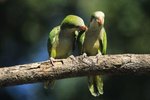
Budgies -- Budgerigar parakeets -- come in a variety of color mutations, and many people "collect" budgies based on the quality of their color. Wild budgies have yellow heads and green bodies. All other color mutations come from captive-bred budgies and come in various qualities. Some budgie color mutations are very rare, while others are common. If you are breeding your budgie for color, it is essential you do everything possible to give your budgies high quality coats and good color.
Take your budgies to a vet to ensure they are healthy. Unchecked birds should not be bred. Ask your vet to estimate your budgies' ages if you are not completely certain of the ages of the budgies; they need to be over one year but preferably closer to 18 months to be ready to raise chicks. The female should be no older than 3, and the male no older than 6. Both birds also need to be in good health -- no discoloration, no discharge from vents, no blocked vents, no problems defecating, no lethargy, no vomiting. These are signs of illness that can be serious. You also need to be sure that the budgies you are considering using are not related -- the closest without huge risk is grandparent to grandchild, although completely unrelated birds is much less of a risk. Be wary if you bought both birds from a pet shop at the same time, as they could be siblings.
Work out the genetics of your budgies, if you are aiming for a particular color. If you are breeding wild-colored budgies, you will end up with very similar offspring. Other colors, such as violet and rainbow, require certain "starting colors" to be created. If you are attempting to breed special colors, be aware that you may not create any chicks with that coloring, or only some may carry it. Ensure that you will be able to home, or find good homes, for the others nestlings, too. Budgie genetics can become very complex, so reading a book on color mutations and genetics before you being breeding is advisable. However, some mutations can be easy to work out. All budgies have a base color, either yellow or white. This is the color of the head, and the color in between the "stripes" on a budgie's neck, leading down to its feathers. Yellow-based budgies will most commonly have bright green bodies, while white-based budgies will most commonly have bright blue bodies. The yellow base is dominant, meaning breeding a yellow-based budgie and a white-based budgie will result in yellow-based offspring. There are also dark counts to consider -- a budgie with no dark counts will be bright colored, one dark count will give a slightly darker color and two a darker color still.
Carefully select the budgies you wish to use for breeding. In most cases, breeding '"communities" of budgies is recommended, as breeding will take less time. However, when breeding for color, it is essential that the correct budgies breed, so keep them together apart from other birds. Consider what you are aiming for, and what you have: For example, if you want to breed white-based cobalt budgies, you require two white-based budgies with either no or one dark count.
Keep the budgies in a large cage, where they have room to fly and plenty of perches and swings. This will allow the budgies time to be apart as well as being together. Overcrowding can cause stress, lowering budgies' immune systems, which makes them more likely to come down with disease or illness. This can affect the condition of their feathers and their parenting skills, which can result in poorer-colored offspring.
Watch for evidence of breeding behavior. Note down when you see this occuring; however, be aware that not all breeding behavior will result in eggs. This does not mean anything is wrong with the pair, and they are likely to breed again and eventually create offspring if left alone. Budgie breeding behavior is often very easy to spot -- a male budgie will approach the female, chattering and tapping her beak repeatedly. The female will respond by raising her tail and lowering her head so the male can balance on top of her and mate. This is usually brief and repeated frequently.
Check your nest boxes regularly. Females will lay a clutch of eggs, usually between two and nine, before incubating them for 18 days. During this incubation period, offer plenty of food and water at all times. Record when the chicks are due and check the nesting box regularly around this time.
Provide a diet with plenty of nutrients and vitamins. Offer a variety of foods such as egg, carrot, leafy greens and eggplant. There should a cuttlebone in the cage, or ground cuttlebone provided, as this will boost calcium levels. Provide regular fruit and vegetables to keep your birds healthy and their feathers looking good. Fresh vegetation is much more beneficial to your bird than a plain seed diet alone.
Observe the chicks' eating habits. For the first few days the female will provide the food; as the chick's get older, the male and female will take turns. The chicks will begin to eat on their own. Do not sell them until they have been eating independently without any influence from their parents.
Spray your budgies with a light misting spray bottle regularly. Fill this with room-temperature water, and give each bird a gentle mist on a regular basis. This will encourage the birds to preen their feathers, leaving them in better condition, which boosts color.
Tips
If you want to improve the color of your budgies further, continue the breeding. Make sure any additional budgies have strong color and good health. Continually breeding healthy, colorful budgies will lead to brighter, bolder colors.
Warnings
Do not be tempted to breed related budgies. This can lead to many syndromes, which prevent affected budgies from having normal lives or being able to climb, fly or even eat correctly.
Resist the urge to remove the male after breeding if possible. While this is a practice of many line breeders so that the male can immediately impregnate another bird, raising a clutch alone puts a large amount of stress on a female bird.
References
- The Budgie and Parakeet Place: Color and Mutation Guide
- "Budgie"; Amanda O'Neill; 2004
- "Budgies (Parakeets) as Pets - A Guide to the Selection Care and Breeding of Parakeets"; 2011
Photo Credits
-
BananaStock/BananaStock/Getty Images
Writer Bio
Elle Blake has been writing since 2006. Her articles regularly appear in "All Women Stalk," "Parenting," "Education Plus" and "Glamour." She has a Bachelor of Arts (Hons.) in early childhood studies and primary education and a Bachelor of Science (Hons.) in animal welfare and behavior, both from the University of Warwick. She is currently studying towards NCTJ Certificate in Magazine and Journalism.