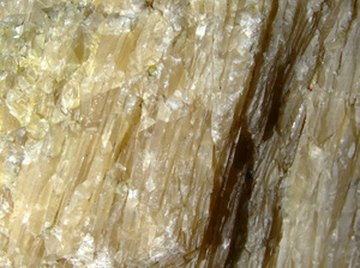
Quartzite is a metamorphic rock, formed when its parent rock, sandstone, is buried then heated and/or compressed. Sandstone is a sedimentary rock, formed from weathered or eroded remains of other rocks. Those rocks can be metamorphic, sedimentary, or igneous (igneous rocks are formed when magma, or molten rock, cools, either inside the earth or on the surface). To understand why quartzite is harder than sandstone, it helps to understand a bit about the rock cycle.
Igneous Rock
Far beneath the surface of the Earth, rocks and minerals that have melted form magma which can become trapped in pockets under the Earth and cool there, or be carried to the surface by volcanic activity, where it is called lava. When it cools, magma, or lava, becomes igneous rock. Below the surface, heat and pressure eventually transform igneous rock into metamorphic rock. Above the surface, wind and water eventually weather away the igneous rock. The particles, called sediment, are carried away to be deposited in layers elsewhere, eventually becoming sedimentary rock.
Sedimentary Rock
As layer upon layer of sediment is deposited, water is squeezed out from between the particles and minerals and pressure cements the particles together, changing them into sedimentary rock. Sandstone, in particular, is a sedimentary rock cemented together by calcite, clay or silica. About 75 percent of the Earth’s surface and almost all the ocean floor is covered by sediments and sedimentary rock, according to University of Kentucky Department of Earth and Environmental Sciences. Sedimentary rock becomes heated, either from pressure, friction, or radioactive decay. As it bakes, it undergoes a metamorphosis, forming crystals, and eventually becomes metamorphic rock.
Metamorphic Rock
Different combinations of heat and pressure on sedimentary rock form different types of metamorphic rock. Quartzite, in particular, can be formed by either high temperature and high pressure or high temperature and low pressure. Crystallization or recrystallization of sedimentary rocks takes place between 700 to 900 degrees Celsius or about 1,300 to 1,650 degrees Fahrenheit, according to NASA’s Classroom of the Future. After this point, the rocks begin to melt, again forming magma beneath the surface of the Earth to begin the process all over again.
Sandstone, the Parent of Quartzite
When the sedimentary rock sandstone is cemented together by the mineral silica, it is known as quartz sandstone. Silica, or quartz, is one of the most abundant minerals in the Earth’s crust. Quartz is a hard, durable mineral, and when the other materials that make up sandstone are weathered away, quartz is often all that remains, and it remains fairly intact. When heat and pressure work on quartz-rich sandstone, the resulting hard metamorphic rock is called quartzite.
Quartzite
Quartzite contains at least 90 percent quartz, and because quartzite is metamorphic, it is hard, compact and resists weathering. It is often found on hills or mountain masses, such as on some ridges of the Appalachian Mountains, according to the Geological Sciences Department at California Polytechnic State University, Pomona. But quartzite formations are found the world over, including in the United States, Canada, Norway, Sweden, Italy and South Africa, though this list is by no means exhaustive.
References
About the Author
Based in Arizona, Kira Jaines writes health/fitness and travel articles, volunteers with Learning Ally and travels throughout the Southwest. She has more than 16 years of experience in transcribing and editing medical reports. Jaines holds a Bachelor of Arts in telecommunications and journalism from Northern Arizona University.
Photo Credits
raw quartz image by FotoWorx from Fotolia.com