What's the difference between an alligator and a crocodile? Crocodiles and alligators are large, superficially similar reptiles belonging to the same order: the crocodilians. Though collectively these toothy aquatic predators range across the Americas, Africa, southern Asia and Australasia, there’s only one place in the world where you could actually find them sharing habitat in the wild: South Florida.
South Florida is home to both the American alligator and the American crocodile.
Here in the greater Everglades ecosystem and its surroundings, the two cousins show a number of physical and ecological differences that -- especially when considered together -- are usually enough to tell an alligator vs crocodile apart without risking close inspection.
What's the Difference Between an Alligator and a Crocodile? The Big Picture
Alligators and crocodiles occupy different branches of the crocodilian family tree. Alligators -- along with their close Central and South American relatives, the caimans -- belong to family Alligatoridae. Crocodiles are in the family Crocodylidae.
There are only two living alligator species: the large, numerous American alligator of the southeastern United States and the substantially smaller -- and much rarer -- Chinese alligator of eastern China.
Distribution-wise, crocodiles are mostly restricted to the tropics -- South Florida represents the northernmost outpost for American crocodiles -- while both American and Chinese alligators, more cold-tolerant, are essentially temperate or subtropical beasts.
The Business End: Jaws and Teeth
The snouts are where the true alligator vs crocodile differences start showing: alligators in general have significantly broader snouts than crocodiles, the mugger crocodile of South Asia, with its heavy, alligator-like head, being a notable exception.
As Dr. Adam Britton notes in the online Crocodilian Biology Database, the more massive dimensions of the alligator’s jaws -- and the resulting crushing power -- may reflect the significant inclusion of well-armored prey, such as turtles and mollusks, in its diet.
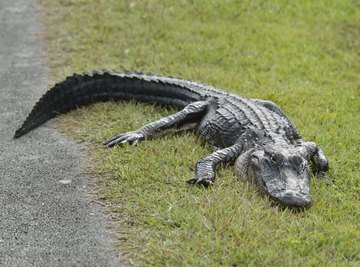
When an alligator’s jaws are closed, meanwhile, only its upper teeth are visible. A close-mouthed crocodile shows interlocked upper and lower teeth, and the fourth bottom tooth -- which slips into a notch just behind the nostrils -- particularly stands out. In short, the narrow-jawed American crocodile simply looks toothier than the broad-nosed alligator.
Hide Color and Pattern
The American alligator is essentially black in color, much darker and glossier than the American crocodile, which is a pale, dusty-looking gray. Young gators are dark with yellowish stripes. Young crocs, in turn, are light with dark speckling.
Get a good look at a Florida crocodilian’s throat or belly and you may discern another difference at the skin level. Most of the body scales of a crocodile show small black dots call sensory pits that, in the alligator, are restricted to the jaws and not found elsewhere. These pits allow crocodilians to monitor movement and pressure variations -- and possibly other variables -- in the surrounding water.
Difference Between Alligators' and Crocodiles' Size
Taking all species into account, the difference between alligators and crocodiles size is small and hard to gauge.
This is certainly the case in South Florida, where gauging the length or mass of a crocodilian won’t do much to aid in identification. American crocodiles may approach 6 meters (20 feet) in rare cases, but most individuals encountered in Florida are some 3.8 meters (12.5 feet) or smaller.
And while the heftiest American alligators may be 4.8 meters (15.75 feet) long and 454 kilograms (1,000 pounds) or more, the animals in the Everglades tend to be substantially smaller than their more northerly brethren.
Alligator vs Crocodile: Habitat Differences
In South Florida, the alligator vs crocodile comparison is easy when you look at their habitats since they tend to favor different core habitats (though they certainly mingle on occasion).
The American crocodile, like other crocs, possesses salt-excreting glands on its tongue and thus can tolerate saline environments. It primarily inhabits the brackish waters of tidal rivers, mangrove swamps and coastal lagoons, though it will readily range farther inland. It also occasionally swims out to sea, a habit that explains its broad historic distribution in the Caribbean.
While alligators sometimes utilize brackish habitat, they are mainly a freshwater creature. The most common settings in which you’d potentially glimpse South Florida alligators and crocodiles crossing paths are at the fringes of mangrove swamps or in upper estuary reaches.
References
- Crocodilian Biology Database: What's the Difference Between a Crocodile and an Alligator?
- Crocodile Specialist Group: Crocodiles, Alligators or Gharials?
- Florida Fish and Wildlife Conservation Commission: Differences Between Crocodiles and Alligators
- Crocodilian Biology Database: What is the Largest Species of Crocodile?
- Crocodilian Biology Database: Alligator mississippiensis
- Cybercast News Service: It's Official: Alabama Family Caught Largest Alligator on Record
- The Physiological Ecology of Vertebrates: A View From Energetics; Brian K. McKnab
- Crocodile Specialist Group: Crocodilian Attacks
About the Author
Ethan Shaw is an independent naturalist and freelance outdoors/nature writer based in Oregon. He holds a B.S. in Wildlife Ecology and a graduate certificate in G.I.S. from the University of Wisconsin-Madison. His primary interests from both a fieldwork and writing perspective include landscape ecology, geomorphology, the classification of ecosystems, biogeography, wildlife/habitat relationships, and historical ecology. He’s written for a variety of outlets, including Earth Touch News, RootsRated, Backpacker, Terrain.org, and Atlas Obscura, and is presently working on a field guide.
Photo Credits
Saddako/iStock/Getty Images