There are few baby animals on the planet cuter or more forgivable than a puppy — until, that is, they start nipping. Whether it's the couch cushions, shoes, hands, arms, or legs, nothing is safe from those little puppy chompers. We spoke with Dr. Shagufta Mulla, a veterinarian with a DVM degree from Colorado State University with 20 years of experience as a small animal veterinarian, to learn more about puppy teething.
Video of the Day
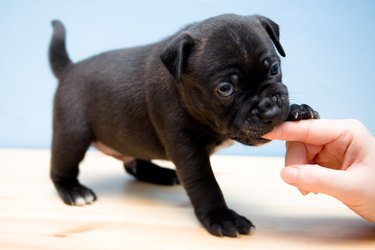
Nipping is both inherent to puppy play and a way to explore the world since tasting is part of their natural development. As much as we can forgive a puppy, biting too hard and other excessively aggressive behaviors should be stymied as early as possible.
Video of the Day
Puppy teething starts at 2 weeks of age
It's not surprising if sharp little puppy teeth seem to have a magnetic attraction to your fingers and toes. Like human babies, a huge part of puppy development stems from exploring the world with their mouth. Unlike human babies, puppy teeth come in as early as 2 weeks of age. So, while nipping starts young, puppies are usually still with their mom or breeder. It isn't until they are about 3 to 4 months old that those needle-sharp puppy teeth start falling out to make room for adult teeth — right around the same time your new puppy comes to your house.
As anyone who has been anywhere near a teething baby can tell you, the process of growing new teeth is not fun. Sore gums, drooling, chewing, biting, and nipping are all signs that your puppy has their permanent teeth coming in. Providing your pup with chew toys and training them to avoid gnawing on furniture or feet will go a long way to help mitigate the biting and will soothe their mouth and gums.

Teething should stop when puppy teeth are gone
A puppy's baby teeth start off as 28 mini razors that fall out over the course of several months. Depending on the dog breed, most lose their baby teeth between 3 and 6 months old, and they tend to become chewing maniacs during this teething phase. Some continue to lose teeth until about 7 months of age.
"If they still have baby teeth after 6 or 7 months of age, which is common in small breed dogs, they likely won't fall out on their own at that point," explains Dr. Mulla. "This can create a crowding issue and also tight contacts where tartar can accumulate." Dr. Mulla says that a good time for the retained baby tooth or teeth to be extracted is when the pet gets spayed or neutered at or after 6 months of age. "This is different for large or giant breeds that will get spayed at 12 months or older, and also because retained baby teeth are unlikely in these dogs," says Dr. Mulla.
After they lose their baby teeth, however, they don't need to chew to relieve mouth pain. It's important to begin correcting nipping and biting behavior at this point because a playful chomp from a mouth full of baby teeth may not be very comfortable, but a mouth full of full-size dog teeth can be severe.
Fortunately, nipping is a habit that you can correct. You can start training a puppy not to nip at around 6 to 8 weeks old, but they might not be able to stop themselves during the teething process. Be patient during this stage; it can be uncomfortable for the puppy, but it doesn't last long.
Training your dog starts early
Nipping is actually a part of early socialization. While puppies play together, they practice nipping and biting. When one pup nips too hard, the other will yelp, crying out to signal pain. Usually, both puppies will stop playing for a little while as they take in this new information. The ability for a dog to control their bite and know when a nip or bite is too hard is called bite inhibition. Puppies can learn bite inhibition from their human family as well.
Any good pet parent wants to set up their adult dog for success. One way to do this is to give them a 10- to 20-second time out from play. When they nip or bite too hard, let out your own little yelp and then stop playing or get up and walk away for several seconds. This will teach them that gentle play is OK, but rough play will stop immediately.
Playing games with your puppy is important, and using toys can help teach them not to chew your hands or arms. Be sure to teach your puppy commands like "leave it" or "let go" to prevent play from becoming too aggressive. Also, remember not to pull away from a bite because that can trigger a chase instinct and make the problem worse.

Appropriate dog chew toys are a must
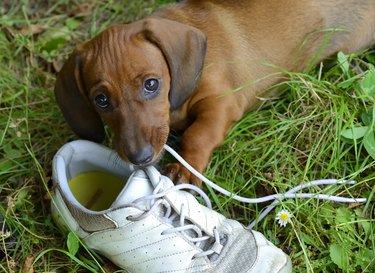
Since the teething period is prime nipping time, providing your pup with appropriate dog toys for puppy chewing can help reduce the amount of time they use you to gnaw on. "Teething toys and silicone or rope chew toys are good choices partly because they have some give to them and your pup is less likely to break their teeth on them," while also serving to redirect their nipping tendencies, explains Dr. Mulla. "Puppies can break their baby teeth on toys that are too hard. Though baby teeth will fall out, breaking them isn't good because the tooth can get infected and can be a source of pain until it falls out, which might be months."
Toys also help remind puppies that there are better options for chewing aside from pet parents. Always end a playtime the moment they start to nip or bite you to reinforce the idea that nipping has negative consequences. Be careful about the roughness of your play. Games like tug-of-war or quick hand movements around their face may be too exciting, rough, or confusing and may keep them from understanding when nipping is and isn't appropriate.
It's very important to monitor your puppy's toys to make sure they can stand up to the rigors of teething. Check their favorites often to make sure there are no holes or pieces missing. Your dog shouldn't have toys that come apart easily, as this can cause choking hazards even after they stop teething.
The bottom line
"By definition, 'teething' is baby teeth coming in, but people often use the phrase to include the phase of puppy teeth falling out and adult teeth coming in, which usually ends by 6 months of age," explains Dr. Mulla. Teething can start at 2 weeks, with the teething behavior like chewing on everything starting later, at about 3 to 6 months. Baby teeth can start falling out at 3 months and ends at 6 to 7 months. Training a puppy not to nip can start at around 6 to 8 weeks old, but they might not be able to stop themselves during the teething process. Provide plenty of chew toys and positive redirecting to keep them chewing on things they are allowed to chew on,