
How to Cut a Composite Hockey Stick
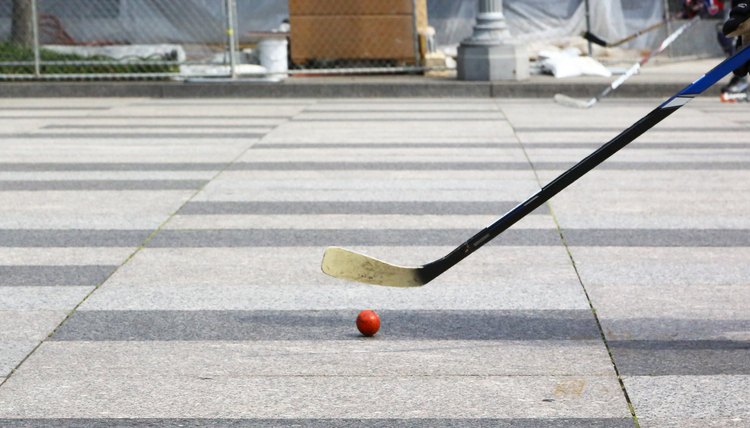
A hockey stick is frequently customized to meet the specific needs of each player. Blade curve and size, manufacturing materials, stick flex and taping methods will all vary from player to player. Stick length varies too, and sticks are often cut down to accommodate a player's height and reach. Newer composite sticks can be cut to specific lengths, with the right preparation and tools. The task is relatively easy and can usually be accomplished in less than 30 minutes.
Remove any hockey tape that may be on the handle of the hockey stick shaft.
Put on your hockey skates. While standing in your skates, place the hockey stick in front of you, so that the toe of the stick is resting on the floor directly in front of you. While hockey stick length is a matter of choice, a good starting point is to measure the shaft of the stick to somewhere at or just below the tip of your chin. Mark the stick with the permanent marker to identify where you will cut the stick.
Make a mark 1 inch above the original mark on the shaft. This will allow for a little extra length in the shaft that can be cut off later, if need be. You can always cut more off the stick, but cut off too much, and it will be useless.
Remove the end cap from the tip of the shaft. Wrap the second mark on the shaft with masking tape. Place the stick in a table vise or other device that will hold it steady.
Use a hacksaw to carefully cut through the masking tape and the stick shaft, using short, clean strokes. Ensure that you are cutting the shaft squarely. Continue sawing completely through the shaft.
Remove the stick from the vise. Peel off the remaining masking tape. Replace the end cap and re-tape the handle of the shaft.
Warnings
Shortening a composite stick alters the flex of the stick, making it stiffer. While taking and inch or two off of a composite stick will not adversely affect the flex, taking off more may make the stick too stiff to play well.
References
Writer Bio
In Jacksonville, Fla., Frank Whittemore is a content strategist with over a decade of experience as a hospital corpsman in the U.S. Navy and a licensed paramedic. He has over 15 years experience writing for several Fortune 500 companies. Whittemore writes on topics in medicine, nature, science, technology, the arts, cuisine, travel and sports.