How To

How to Design a Garden Path

Contributor
By eHow Contributing Writer
(23 Ratings)

Paths first serve a utilitarian function, making it easy to walk from
point A to point B. A basic path directs pedestrians pleasantly and
safely, keeping shoes dry in the process. But a well-designed path
does much more, inviting, sometimes hiding or revealing views, and
stimulating the senses. Paths also add interest to the garden by connecting
and unifying unrelated areas.

Difficulty: Moderate
Instructions
  1. Step 1

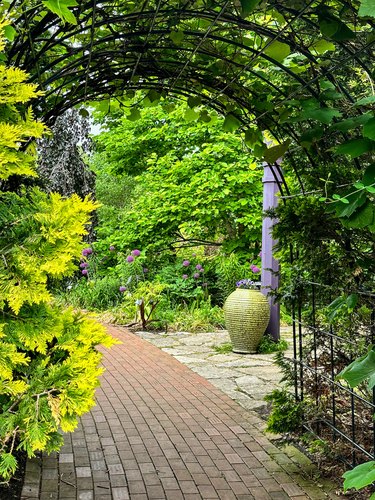
    Lay out the location and shape of the path. All things being equal, people walk in straight lines and will cut across right angle corners. Straight paths are predictable--but paths that disappear around a tree or a corner are more interesting, as well as more natural-looking. If a tree or boulder is in the way, curve your path around it. If a slope is too steep, put in a switchback.

  2. Step 2

    Make entry paths about 4 feet (1.2 m) wide so two people can walk side by side. Secondary garden paths, used by one person at a time, are narrower, from 30 to 36 inches (76 to 91 cm) wide.

  3. Step 3

    Choose a paving material that is suitable to its intended use. A path that will receive regular use needs to be solid, evenly set and not slippery. The best choices are brick or concrete pavers, poured concrete, cut stones or large stones set close together. Think about what materials would complement your house and its natural surroundings. Stroll through various neighborhoods and thumb through garden magazines to get ideas.

  4. Step 4

    Make sure the path won't bog down in water. In order to drain correctly, solid paths of concrete, brick or stone need to slope away from the house at 1⁄8 inch for every foot of length (1 degree), or 1⁄4 inch per foot of width (2 degrees). Or make the finished path about 1⁄2 inch (1.3 cm) higher than the adjacent grade.

  5. Step 5

    Excavate a sufficiently deep gravel base to ensure that pavers stay level for years to come. In the South and West, where the ground doesn't freeze, make the gravel base about 4 inches (10 cm) deep. In soils that do freeze, make your base 5 to 8 inches (13 to 20 cm) deep. Confirm with a local supplier.

  6. Step 6

    Add a 1- to 2-inch (2.5 to 5 cm) layer of leveling sand over the gravel so that you can nudge a stone or brick slightly until it's in just the right position. If weeds are a likely problem, lay down a layer of landscape fabric over the gravel before adding the sand.

  7. Step 7

    Use an edging to hold closely laid pavers in place. Edgings are commonly made of masonry, aluminum or steel.

  8. Step 8

    Use low-growing plants such as blue fescue (Festuca), candytuft (Iberis) or bush germander (Teucrium) along path edges to make the transition from path to landscape more graceful. Fill gaps between pavers with green carpet (Herniaria), blue star creeper (Laurentia), baby's tears (Soleirolia) or creeping (or woolly) thyme.

Tips & Warnings
  • Consider adding a section of 2-inch (5 cm) PVC piping over the gravel and under the path. Then if you need to run a water or electrical line across the path in the future, you won't have to dig up a section.
  • Make a path wide enough to accommodate necessary equipment. A lawnmower needs 3 to 3 1/2 feet (91 to 107 cm); a garden tractor, 5 feet (1.5 m) or more.
  • Chose a paving material for primary paths that will provide safe passage during inclement weather. For instance, avoid using slate or marble where rain is common because they are slippery. Where snow and ice are common, consider paving with a rough surface for more stable footing.
  • Consider drainage even with highly porous gravel paths, taking care to steer them around low spots that routinely flood.

Post a Comment

Post a Comment
  • Have you done this? Click here to let us know.
I Did This

Related Ads

Home & Garden
Ruby Bayan,

Meet Ruby Bayan eHow's Home & Garden Expert.

Get Free Home & Garden Newsletters

Copyright © 1999-2009 eHow, Inc. Use of this web site constitutes acceptance of the eHow Terms of Use and Privacy Policy.   en-US

eHow Home and Garden
eHow_eHow Home and Garden