
How to Learn Hung Gar Kung Fu
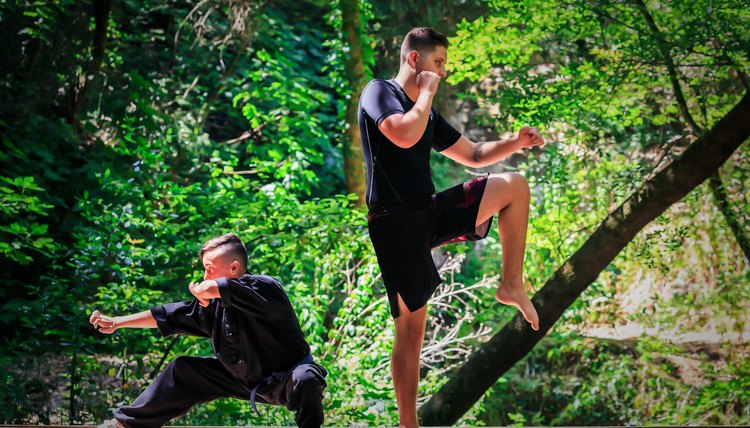
Hung Gar is a southern Chinese style of kung fu developed in the 19th century. Like other Chinese martial arts, Hung Gar has its roots in the Shaolin form of kung fu and its five animal styles: dragon, tiger, crane, snake and leopard.
Hung Gar is primarily a tiger style, according to the Mooresville, North Carolina, Hung Gar Kung Fu Academy's website, but also incorporates techniques from the other animal styles. This style of kung fu emphasizes strong stances, powerful hand strikes and low kicks.
Learn Basic Stances
Hung Gar uses various stances, but the horse stance is a basic position from which you can practice many of the style’s techniques. Strong stances provide a foundation for good kung fu technique. In addition, practicing the horse stance develops balance.
Form a horse stance by standing with your feet twice as wide as the width of your shoulders. Distribute your body weight evenly between both legs with your feet pointing forward. Then bend your knees and sink down into the stance, keeping your back straight and buttocks tucked under. Keep your shoulders centered over your hips, leaning neither forward nor back.
Practice holding this stance for longer and longer periods of time. In traditional hung gar training, students are required to stay in horse stance for long periods of time -- up to one hour, according to the Lam Ka Hung Kuen website.
Read more: Jiu Jitsu Vs. Kung Fu
Practice Striking
Proper exertion of force is a foundation of hung gar training. Tense the forearms, elbows and triceps, which will help you deliver power in each punch. Practice striking while standing in horse stance. Form fists with your palm facing upward and the fingers curled into the palm. Your thumb, meanwhile, should be tight against the index and middle fingers.
Cock both arms by holding tight fists against your hips, with your elbows pointed back. Using a heavy bag for practice, punch the bag, alternating between the right and left hands. When striking the bag, your palm should face down. The Hung Gar Kung Fu Academy advises starting soft with your fist training. Striking objects too hard before the fists are properly conditioned can cause injury.
Learn the Tiger Claw Technique
There are several hand forms in hung gar, including the leopard paw, snake fist and crane's beak. One of the most common, the tiger claw technique uses the palm for striking and the fingers for grabbing and gouging. An effective tiger claw targets the temple, eyes, throat and other sensitive areas of an opponent.
To make a tiger claw, extend your arms, palms facing outward, then curl your fingers forward to form claws. Practice striking using a heavy bag for practice, extending your hand forward and striking the bag with your palm. Alternate between the right and left hands as you practice this technique.
Strengthen your hands by grasping the mouth of a round fish bowl with your tiger claw. Extend your arm straight out in front of you at shoulder height. Practice this in horse stance, holding the bowl as long as you can. As your hands get stronger, you can increase the weight of the bowl by adding rocks or sand.
Find a Teacher
To learn more than the basics, it helps to learn from a trained instructor. Traditional training is very slow and regimented. You learn techniques in a controlled manner, and you're only allowed to advance if your teacher believes you are ready. Attend lessons regularly and practice your techniques outside of class.
Read more: The Basic Techniques of Shaolin Kung Fu
Writer Bio
Shane Hall is a writer and research analyst with more than 20 years of experience. His work has appeared in "Brookings Papers on Education Policy," "Population and Development" and various Texas newspapers. Hall has a Doctor of Philosophy in political economy and is a former college instructor of economics and political science.