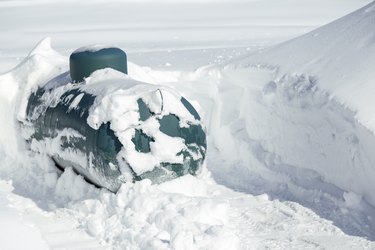
Cold outside temperatures not only freeze lakes, streams, and fingers, but they affect propane tanks as well. Propane or liquefied petroleum gas commonly provides the fuel for a backyard barbecue grill or house furnace and comes in metal cylinders or tanks. The storage container uses pressure to keep propane in a liquid form, and proper propane tank storage is essential to safety. Propane appliances might not function correctly if the outside temperature surrounding a propane tank becomes too cold.
Similarities Between Propane and Water
Video of the Day
Liquid propane and water act similarly when temperature drops, but their boiling points differ. At sea level, propane begins to boil at a temperature of -44 degrees Fahrenheit and produces propane vapor, while water boils at 212 degrees F and produces water vapor. As the temperature drops below 212 degrees F, water stays in liquid form and doesn't change to a vapor. Similarly, as the temperature outside the propane tank drops and approaches -44 degrees F, less propane boils inside the storage tank producing less vapor and a lower pressure.
Video of the Day
Critical Propane Temperature
As the pressure inside the propane tank drops, it eventually becomes too low to light a furnace or other appliances. At -44 degrees F or lower, propane stays as a liquid, there is little vapor, and propane appliances won't function properly. For appliances to work correctly, a propane tank must usually be kept in an area with a temperature that's greater than -44 degrees F.
Most areas don't get that cold, even in the middle of winter, but even temperatures above -44 degrees F can cause issues with your propane tank. Cold temperatures can cause the propane to shrink, which can decrease the pressure inside the tank. This can make gauge readings inaccurate. If the pressure drops too low, the fuel might not be able to reach your propane appliances.
Handling Cold Temperatures
In climates where the temperature may drop to well below 0 degrees F, keep your tank at least 30 percent full at all times to keep the pressure higher. You can use a small insulated frame shelter for your propane tanks. Applying a heat tape specifically designed for propane tanks may keep the tank above -44 degrees F. Sometimes propane tanks are buried to protect them from cold temperatures.
Cold Weather and Propane Delivery
Many propane tanks contain a tank gauge to show the percentage of propane in the tank. During propane deliveries to refill propane tanks in cold weather, the gauge may show less propane delivered based on the beginning and ending gauge readings than is actually delivered. However, the meters used to measure the amount of propane delivered include a volume correction device that takes into account cold temperatures. Therefore, an accurate measurement is possible in cold as well as warm temperatures.
Other Cold Weather Problems
When heavy snow and ice accompany cold temperatures, additional precautions become necessary. Ice and snow must be cleared from the propane tank regulators, vents, piping, and valves to prevent damage that could cause a gas leak. Ice and snow must also be removed from any appliance vents, flues, and chimneys to allow the gas to vent properly. To find the tank in heavy snow, a flag, pole, or stake next to the tank shows the location.
Propane is flammable when mixed with oxygen. Be sure to turn off the main gas supply if an appliance fails to light or if a gas leak is detected.