

How to Design a Home Plumbing System

Home plumbing systems must bring hot and cold water to the kitchen, bathrooms, laundry room and exterior taps at adequate pressures and in the required volumes. They must safely remove waste water while venting waste water odors and gases and keeping them out of the living quarters.
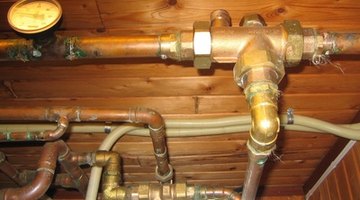
For the water supply, there must be shut-off valves for the entire system and for each unit supplied with water so that individual units can be shut down without affecting the entire system. Piping used to be made out of metal but it is now mostly made out of plastic, polybutylene (PB) or cross-linked polyethylene (PEX) for supply lines and white PVC or black ABS plastic for drain piping.
Waste Water System
-
Decide where to place your main stack. The main stack is a large pipe, usually 3 or 4 inches in diameter, that passes through the building from the basement to the roof. The lower part collects waste from toilets, the middle part collects waste water from other fixtures and the top part is used for venting. Venting is needed to equalize the pressure in the system as water pours through the pipes and pushes air in front of it or pulls air in behind it.
-
Fixtures must be within about 5 feet of the main stack or they will need larger drain pipes or separate venting. If a bathroom is located far from the main stack, it may have its own stack rising through the roof and joining with the lower section of the main stack.
-
Place your drains and vents. Drain and vent pipes are usually 1 1/2 or 2 inches. Pipes must slant 1/4 inch per foot to drain well. Bends to join the stack or other main drains must be smooth, not angled sharply, to promote smooth water flow. This means using two 45 degree angles for a slow turn rather than one 90 degree angle.
-
Each fixture (except a toilet) must have a trap, which is a U-shaped bend in the pipe under the fixture. This bend traps water and prevents gases and odors from entering the living quarters. Toilets have their own built-in trap and, therefore, must not have another one in the piping.
-
Each fixture must be vented. Fixtures located within 5 feet of the main stack and connected with a pipe 2 inches or larger can be "wet" vented, which means that there is enough room in the drain pipe for both waste and air flow simultaneously. If the pipe is longer, water may flow slowly and block the pipe, thus blocking air circulation and venting. For these cases, an additional pipe must be run from the fixture drain pipe up to join the main stack at the venting section.
-
Prepare a rough-in plumbing diagram. Many jurisdictions require this diagram to get a permit. The diagram shows all drainage pipes, pipe fittings and vents in a three-dimensional perspective drawing. It shows all pipe sizes, traps, vents and angles of connection. The building inspector uses the diagram to make sure the design is acceptable and the proposed installation satisfies the local building codes.
Fresh Water Supply System
-
Place the hot water tank in the design. For smaller installations 1/2-inch pipe can be used throughout the house but 3/4-inch pipe is needed for the main pipes of larger homes. The cold water pipe needs a shut-off valve and then is split with one branch attached to the cold water fitting of the hot water tank. The hot water pipe starts from the top of the hot water tank and needs a shut-off valve in order for the cold water/hot water pipe pair to be ready for distribution.
-
Determine the paths of the cold water/hot water pipe runs. It is possible to run a pair of pipes to each fixture from a manifold in the basement, but it is more common to run a pipe pair to each fixture group and to distribute the water from there.
-
Run 3/4-inch pipe for runs that will supply more than one grouping of fixtures. Run 1/2-inch pipes to the fixtures. Special fixtures such as spa-type bathtubs and rainhead showers may work better with 3/4-inch pipe all the way to the fixture. The 3/4-inch pipe supplies more water volume at a higher pressure even if the fixture itself has only 1/2-inch fittings. If fixtures in a group can be located along one wall or along two walls, the piping will be considerably easier.
-
Design the final runs to each fixture for the rough-in supply pipes. Sinks normally have the two pipes coming out of the wall just below the bottom of the sink. Toilets have the cold water pipe coming out of the wall under the tank. Tubs and showers are custom designed depending on the arrangement of taps, temperature controls, faucets and shower heads. Washing machines have the two pipes brought out close to the side or behind the machine and the pipes need shut-off valves. Shut-off valves for the other fixtures are added when the final connections to each unit are done.
References
Writer Bio
Bert Markgraf is a freelance writer with a strong science and engineering background. He started writing technical papers while working as an engineer in the 1980s. More recently, after starting his own business in IT, he helped organize an online community for which he wrote and edited articles as managing editor, business and economics. He holds a Bachelor of Science degree from McGill University.
Photo Credits
- plumbing image by Inger Anne Hulbækdal from Fotolia.com
- plumbing image by Inger Anne Hulbækdal from Fotolia.com
More Articles

