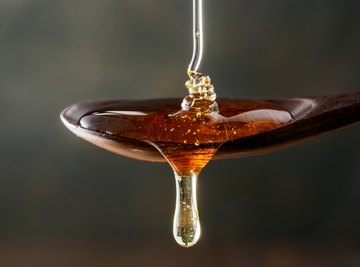

Liquid viscosity is a measure of the internal friction of a liquid. Liquids with high viscosities flow slowly, whereas low viscosity liquids flow quickly. Lava has a relatively high viscosity; water has a relatively low one. You can measure the viscosity of a liquid by measuring the velocity of a sphere as it falls through the liquid. The velocity of the sphere, combined with the relative densities of the sphere and the liquid, can be used to calculate the viscosity of the liquid.
TL;DR (Too Long; Didn't Read)
By measuring the speed of a metal ball dropped in a container of liquid, you can determine the liquid's viscosity.
Calculating the Density of the Ball
Measure the mass of your ball, using your balance. For instance, suppose the mass of the ball is 0.1 kilograms (kg).
Find the radius of the ball by first measuring the diameter (distance of a straight line through the ball at the widest part). Divide the diameter by 2; this gives the radius of your ball. Calculate the volume of the ball by plugging the radius into the equation for the volume of a sphere. Suppose the ball bearing has a radius of 0.01 meter (m). The volume would be:
Calculate the density of the ball by dividing its mass by its volume. The density of the ball in the example would be:
Calculating the Density of the Liquid
Measure the mass of your graduated cylinder when it is empty. Then measure the mass of your graduated cylinder with 100 millilters (mL) of liquid in it. Suppose the empty cylinder had a mass of 0.2 kg, and with fluid its mass was 0.45 kg.
Determine the mass of the fluid by subtracting the mass of the empty cylinder from the mass of the cylinder with the fluid. In the example: Mass of liquid = 0.45 kg - 0.2 kg = 0.25 kg
Determine the density of the fluid by dividing its mass by its volume. Example:
1 mL is equal to 1 cm3 and 1 million cubic centimeters equal 1 cubic meter
Measuring the Viscosity of the Liquid
Fill your tall graduated cylinder with the liquid so it is about 2 cm from the top of the cylinder. Use your marker to make a mark 2 cm below the surface of the liquid. Mark another line 2 cm from the bottom of the cylinder.
Measure the distance between the two marks on the graduated cylinder. Suppose that the distance is 0.3 m.
Let the ball go on the surface of the liquid and use your stopwatch to time how long it takes for the ball to fall from the first mark to the second mark. Suppose it took the ball 6 seconds (s) to fall the distance.
Calculate the velocity of the falling ball by dividing the distance it fell by the time it took. In the example:
Calculate the viscosity of the liquid from the data you have collected:
where g = acceleration due to gravity = 9.8 m/s2 a = radius of ball bearing v = velocity of ball bearing through liquid
Plug your measurements into the equation to calculate the viscosity of the liquid. For the example, the calculation would look like this:
Things You'll Need
- Balance
- Meter stick
- Large graduated cylinder
- Small metal ball
- Marker
- Stopwatch
References
About the Author
Timothy Banas has a master's degree in biophysics and was a high school science teacher in Chicago for seven years. He has since been working as a trading systems analyst, standardized test item developer, and freelance writer. As a freelancer, he has written articles on everything from personal finances to computer technology.