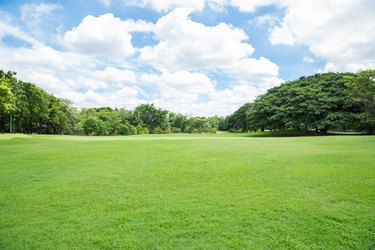
St. Augustine grass (Stenotaphrum secundatum, USDA zones 8-10) is a tropical grass that is the most popular turf from Florida to central Texas. It naturally forms a dense turf and also has a good salt tolerance. But you have to pay for all these great qualities by performing regular maintenance. If you have a yard carpeted with St. Augustine grass, it's important to know how to care for it so it stays thick, green and beautiful.
St. Augustine Grass Basics
Video of the Day
If you're looking for a dense turf that thrives in a warm, coastal climate, you can't do better than St. Augustine grass. The turf is an attractive green and grows well in most types of soil. Its excellent shade tolerance gives it an edge over rival Bermuda grass.
Video of the Day
This isn't a cold-hardy turf. As long as the soil temperature remains above 60 degrees, your St. Augustine grass remains green. The lower the soil temperature, the slower the growth. The turf goes dormant when temperatures drop below 55 degrees. Another limitation of St. Augustine grass is that it can't take too much traffic. If you're using it as a home lawn, you should be fine, but it won't do for an athletic field.
Care and Feeding of Your Turf
St. Augustine grass will let you know when it needs to be watered, and that's the only time you should water it. Normally a solid green, the grass turns a bluish hue when it needs water. When you do irrigate, do it in the morning and water deeply, to a depth of 3 or 4 inches, to encourage deeper roots.
Alternatively, walk across your lawn, watching your footprints. If the grass doesn't spring right back up, it needs water. If you live in an area with plentiful rain, you won't have to water very often.
Fertilizing St. Augustine grass with nitrogen is essential for deep, rich color and attractive density. If your soil is sandy, give your grass monthly applications of one pound of nitrogen per 1,000 square feet of lawn from early spring through late fall. On heavier soils, cut the amount of nitrogen in half.
Keep your grass thick and healthy by mowing with a sharp blade. The ideal height for St. Augustine grass is 2.5 to 4 inches, depending on site conditions. If you mow grass shorter than this, you'll stress the grass and leaf blades, which will make the blades look less green. Dull lawn mower blades make rough cuts, causing the grass to look brown.
Insects and Diseases
Enemy No. 1 of St. Augustine, at least in terms of insects, is the ant-sized chinch bug. It pierces the grass and sucks out the juices, leaving chinch saliva, which is damaging to the grass. If your grass begins to yellow and look stressed, this could be the problem. Use chinch-bug-specific insecticides to control them.
Primary diseases of St. Augustine turf include brown patch, take-all root rot and gray leaf spot. These occur in hot, wet weather. Excess nitrogen and irrigation can encourage these diseases, so keep to the program. Assuming you planted the turf in well-draining soil, a fungicide specific for this grass will take care of these issues.
Preventing Thatch
Thatch is an organic layer that develops between the soil and grass vegetation and consists of shed roots, stems and grass debris. It can become a barrier that prevents water and fertilizer from reaching the roots.
Prevent thatch by taking proper care of the grass. Thatch results from overfertilization and excess watering, so avoid these two missteps. If you do get thatch, aerate with a core aerator. You can also scatter organic matter on the grass. This feeds the beneficial microorganisms that then eat the thatch. As a last resort, rent a dethatching machine.
Repairing St. Augustine Grass
If your lawn has been long neglected, you may be more interested in repairing your St. Augustine grass than maintaining it. In fact, the same steps you use to maintain the turf are the ones that will help it repair itself most effectively.
What exactly should you do? First, make a "keep off the grass" rule for the indefinite future. Until the grass is in better shape, you don't want people walking on it. Fertilize the grass twice as often but use half as much fertilizer to provide it with constant nutrition. Likewise, water it well during the spring-to-fall growing season.
A healthy turf will shoulder out weeds, but your damaged turf might not. Use a general broadleaf weed killer designed for St. Augustine lawns, but don't do it within a week of mowing. Mow the grass as usual to 3.5 to 4 inches. Skip the bare spots in the lawn. These measures will repair your St. Augustine grass and have it looking good again before you know it.