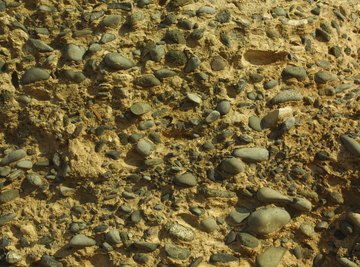

A cubic yard is a unit of measure determined by the volume of a cube of material when you measure its length, width and depth and divide the result by 27. In some instances, such as when measuring amounts of waste, materials are given in cubic yards instead of pounds. While these two units are measuring two different things -- volume and weight -- you can convert one to the other if you know the density of the material you are working with.
Write down the amount of material you have in cubic yards. As an example, 3 cubic yards of clay.
Divide the mass of the material in grams by the volume of the material in milliliters to calculate the density of the material you are working with. For example, the clay you are working with has a mass of 6 grams and a volume 4.8 milliliters. Dividing the mass by the volume gives you 1.25 g/mL.
Multiply the density by 1,685.55 to convert the result to pounds per cubic yard. In the example, multiplying 1.25 by 1,685.55 gives you 2,106.94 pounds per cubic foot.
Multiply the amount of material in cubic yards by the density of the material as calculated to convert to pounds. In the example, multiply 3 by 2,106.94 to get 6,320.82 pounds.
References
About the Author
Based in Halifax, Nova Scotia, Jordan Whitehouse has been writing on food and drink, small business, and community development since 2004. His work has appeared in a wide range of online and print publications across Canada, including Atlantic Business Magazine, The Grid and Halifax Magazine. Whitehouse studied English literature and psychology at Queen's University, and book and magazine publishing at Centennial College.
Photo Credits
Hemera Technologies/AbleStock.com/Getty Images