You've seen many phase changes before whether you know it or not. In particular, you are probably most familiar with the phase changes that water goes through. You've probably boiled water to make pasta. Or frozen water solid to make ice. You've probably even seen frost on the grass in the winter.
All of these changes in the phase of water are accompanied by either an input or output of heat, so they are either an endothermic reaction or an exothermic reaction.
Energy Change Accompanies All Phase Changes
The question then follows, what kind of change in energy accompanies each phase change? To understand this, think about the movement of the particles in each phase. You also need to think about how attracted the molecules are to each other within the phase.
Solids contain particles that aren't moving so much as compared to a liquid or a gas. They have some thermal motion, but clearly not the same amount as a liquid or a gas. Only after adding energy (or heat) do these particles start to move around faster.
Think about a piece of ice. The molecules of water in the piece of ice are not moving much until the water starts to melt. What allows the water to melt? Well, it's an addition of heat.
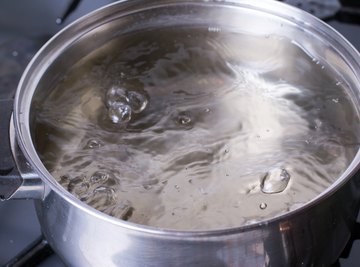
What about when you boil water? You need to put the water over a flame in order to add heat to the system and have the water boil in order to make water vapor.
This input of energy is also enough to overcome the attractive forces that hold the particles together. Water is a good example of a substance that has substantial intermolecular forces holding it together. Water likes to stick to itself though hydrogen bonding. Thus the energy that is input must be enough to have the molecules stop sticking to themselves so much.
This means that as you move from solid to liquid to gas, all accompanying phase changes require the input of heat. Thus, these phase changes are an example of an endothermic reaction.
On the other hand, moving from gas to liquid to solid requires the opposite: Heat must be released. These phase changes are called exothermic reactions.
In order to make liquid water into ice you must put the water into a cold environment so that heat leaves the water. Only then will the water freeze.
When your hand touches steam, you feel heat because the steam immediately condenses upon touching your skin. The release of energy is felt as heat as the water vapor goes to water.
Exothermic vs. Endothermic
Here is how to classify the phase changes as endothermic or exothermic:
Phase Change Name: Freezing
- Phase: Liquid to solid
- Energy Change: Exothermic
- Example: Freezing water
Phase Change Name: Melting
- Phase: Solid to liquid
- Energy Change: Endothermic
- Example: Ice melting
Phase Change Name: Condensation
- Phase: Gas to liquid
- Energy Change: Exothermic
- Example: Water vapor burns
Phase Change Name: Evaporation
- Phase: Liquid to gas
- Energy Change: Endothermic
- Example: Boiling water
Phase Change Name: Sublimation
- Phase: Solid to gas
- Energy Change: Endothermic
- Example: Dry ice
Phase Change Name: Deposition
- Phase: Gas to solid
- Energy Change: Exothermic
- Example: Formation of frost
A good way to remember all of these is that opposite phase changes have opposite energy needs. If you know that from solid to liquid to gas requires the addition of heat (endothermic), that means you know that going from gas to liquid to solid requires the removal of heat (exothermic).
Tips
When going from a more ordered state to a less ordered state, the process is exothermic. When going from a less ordered state to more ordered state, the process is endothermic.
References
About the Author
Riti Gupta holds a Honors Bachelors degree in Biochemistry from the University of Oregon and a PhD in biology from Johns Hopkins University. She has an interest in astrobiology and manned spaceflight. She has over 10 years of biology research experience in academia. She currently teaches classes in biochemistry, biology, biophysics, astrobiology, as well as high school AP Biology and Chemistry test prep.