Wood and water just don't mix. Sealed and waxed floors may become stained if water sits on their surface for more than a few minutes. Here's how to repair the damage.
Step 1
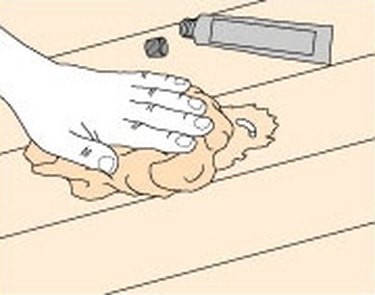
To remove a smoky white haze or a white spot, buff the finish with a soft cotton cloth and a very mild abrasive, such as whitening toothpaste, auto-polishing compound, or tobacco ash mixed with mineral oil, until the stain disappears (see A).
Video of the Day
Step 2
Mask off the surrounding boards with painter's masking tape.
Step 3
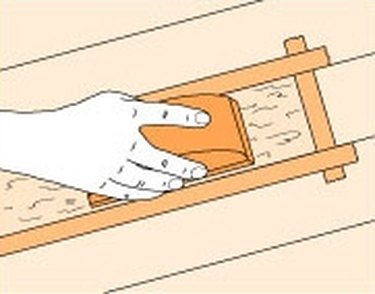
First remove any wax or surface finish. Use fine steel wool to remove wax, and sandpaper to remove a surface finish. Depending on the size of the repair area, hand-sand with a rubber sanding block (see B) or machine-sand with a random-orbit sander. In both cases, start with 80- or even 60-grit abrasive and sand to 100-grit. Sand just up to the edges of unaffected boards.
Step 4
Mix oxalic acid crystals (available at paint or hardware stores) in 1 cup (8 fl oz/250 ml) or so of hot water and stir to dissolve them. Keep adding crystals until they won't dissolve anymore.
Step 5
Pour, brush or sponge the solution on the stained area. When it is completely dry, brush off the crystals and repeat the process until the stain is gone.
Step 6
Stain or seal, then refinish the affected area (see How to Replace a Wood Floorboard). Or, if the touch-up stands out too much, use the screen-and-overcoat method to restore the entire floor (see How to Restore a Dull, Worn Wood Floor).
Video of the Day