Density and concentration both describe the amount of a solute per unit volume of a solvent. The former value measures mass per volume. The latter value measures how many moles of atoms exist per unit volume. The solute's mass tells you how many moles it contains. You can calculate the solution's mass as long as you know the solute and solvent's mass. The solution's density then lets you calculate its volume.
Divide the solute's mass by its molar mass. If, for instance, the solution contains 30 grams of silver nitrate, which has a molar mass of 169.88: 30 / 169.88 = 0.176 moles.
Add the mass of the solute to the mass of the solvent. If the silver nitrate is dissolved in 70 grams of water: 30 + 70 = 100 grams.
Divide this answer by the solution's density. If its density is 1.622 grams per cubic centimeter: 100 / 1.622 = 61.65. This answer is the solution's volume, measured in cubic centimeters.
Divide your answer by 1,000 to convert it to liters: 61.65 / 1,000 = 0.06165.
Divide the answer to Step 1 by the answer to Step 4: 0.176 / 0.06165 = 2.85 moles per liter.
References
Resources
About the Author
Ryan Menezes is a professional writer and blogger. He has a Bachelor of Science in journalism from Boston University and has written for the American Civil Liberties Union, the marketing firm InSegment and the project management service Assembla. He is also a member of Mensa and the American Parliamentary Debate Association.
Photo Credits
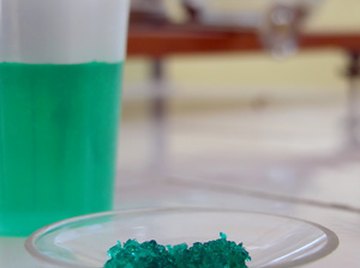
solution and powder image by Radu Razvan from Fotolia.com