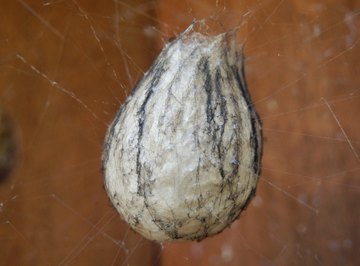
Spiders might give you the willies, especially in your house. They also might be your best friend in the garden, eating pest insects. In either case, using egg sacs can be one way to identify spiders in your house or yard. All of the 40,000 known species of spiders lay eggs and most of them encapsulate their eggs in a sac made of silk, much like the silk that some spiders use to spin webs. Some, such as the wolf spider, carry their eggs on their back, making identification easy, but others require closer examination.
Identifying Spider Egg Sacs
- Magnifying glass
- Pin
- Field guide or online identification guide
Universities and state agencies often have spider field guides that are specific to your area.
Some spiders have painful or poisonous bites, so be careful that there are no adult spiders nearby when you examine the egg sac.
Make sure that you have a spider egg sac. Insects trapped in spider webs and wrapped in silk can look much like egg sacs. Other insects such as moths make silk pupal cases that could be mistaken for egg sacs, often in leaves or dead vegetation. Opening the sac with a pin and examining the contents with a magnifying glass can help rule out these possibilities.
Note where the sac was found. Egg sacs may be associated with a spider-built structure, such as a web or a burrow. The shape and location of the web or burrow can help you narrow down the species. Alternatively, you might find egg sacs in sheltered areas within your house or associated with vegetation, such as the underside of leaves. Some species of spiders prefer the former, while others prefer the latter.
Note the physical description of any spiders you see in the area around the egg sac. Most spiders die after reproducing, but knowing the species that live in the area can help you narrow down the identity of the spider that left your egg sac.
Note the shape and color of the egg sac. Most egg sacs are white or cream colored, but others can be yellow or even light green, such as the green lynx spider. It is also good to note if the egg sac is round or oblong and if it has any bumps or spikes. The egg sac of the brown widow spider is round with distinctive spikes, whereas that of the black widow is round and smooth.
Note the time of year. Many spiders hatch out of egg sacs in the spring, but noting the date you found the egg sac can limit your search to species that were mating during that time.
Use a guide to identify your spider. Using a printed or online field guide to spider species, you can see what spiders live in your area and use the information you collected to narrow down the possible species that laid your egg sac.
Things You'll Need
Tips
Warnings
References
About the Author
Based in Wenatchee, Wash., Andrea Becker specializes in biology, ecology and environmental sciences. She has written peer-reviewed articles in the "Journal of Wildlife Management," policy documents,and educational materials. She holds a Master of Science in wildlife management from Iowa State University. She was once charged by a grizzly bear while on the job.
Photo Credits
PlazacCameraman/iStock/Getty Images