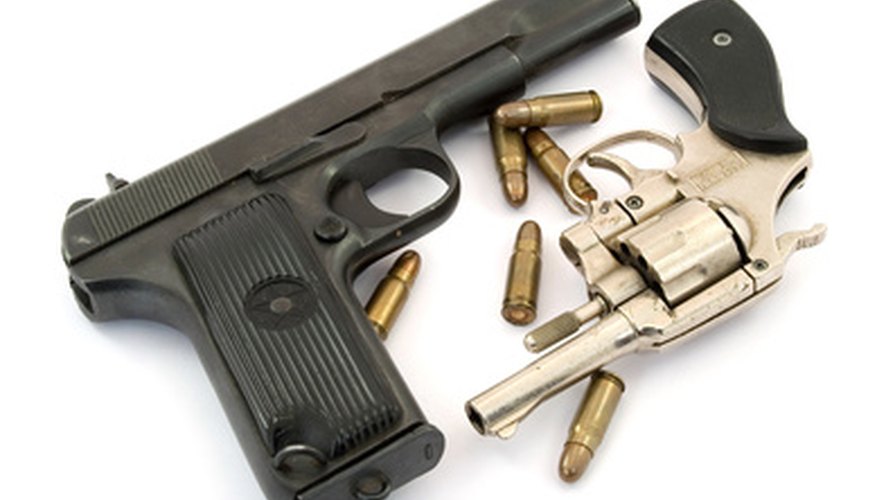



Regardless of your background or situation, obtaining a gun license in Pittsburgh takes a little time and plenty of documentation. The state requires no license or permit for its citizens to own rifles or shotguns, but Pennsylvanians must have a license to carry a gun. The Allegheny County Sheriff is required by law to issue licenses to carry a handgun in Pittsburgh.
Complete an Application
Load the application for a "Pennsylvania License to Carry Firearms" from the website of the Allegheny County Sheriff. This application is in interactive PDF format so you can type all the required information straight onto the application form. You'll need the full names, addresses and contact information for two references who are not family members and who live in Pennsylvania. Save a copy to your computer and print two copies when you've completed the form.
Gather Proof of ID
You'll need a Pennsylvania driver's license or state identification card and at least one secondary form of identification. This can be a voter's registration card, vehicle registration, a current W-2 form, a hunting or fishing license or a state-issued professional license. The addresses on both forms of identification must be the same. Make photocopies of your ID if you'll be mailing in your application. Otherwise, if you're emailing it, scan the two IDs and save the images to your computer.
Submit Your Application
Attach the PDF copies of your two forms of identification and the completed application to an email that includes the contact information for your two references. Send the e-mail to firearms@alleghenycourts.us.
If you're mailing the application, send it and the copies of your identification to Allegheny County Sheriff's Office ATTN: Firearms 436 Grant Street, Room G8 Pittsburgh, PA 15219. Print the application on the front and back of one sheet. Don't forget to include contact information for your references.
Pick Up Your License
You'll receive a yellow card in the mail from the Sheriff's Office when your application is approved. You can pick up your gun license by taking it, along with payment, to the Firearms Office in Room G8 of the Allegheny County Courthouse. As of 2017, the fee for a license is $20 and it must be paid in cash. Try to arrive before 2:30 p.m. so you can get your license the same day.
Some Additional Rules
If you are not a U.S. citizen but are living in Allegheny County, you will need to apply in person at the Firearms Office with additional documentation. Along with the two forms of ID and two references, non-citizens must provide their immigration papers or card, their immigration number, and copies of utility bills for the previous three months.
While some states check only criminal backgrounds before issuing gun permits, Pennsylvania allows sheriffs to deny applications for permits based only on questionable character.
It is unlawful for any person convicted of a crime of violence, including murder, rape, assault or burglary, to own or possess a handgun in Pennsylvania.
References
Tips
- A Pittsburgh law states that if you lose your handgun or have it stolen, you must report the loss or theft to the police within 24 hours or risk incurring steep fines and possible jail time. As of summer 2010, the National Rifle Association was appealing this law.
Warnings
- If you are not a U.S. citizen but are living in Allegheny County, you will need to apply in person at the Firearms Office with additional documentation. Along with the two forms of ID and two references, non-citizens must provide their immigration papers or card, their immigration number, and copies of utility bills for the previous three months.
- While some states check only criminal backgrounds before issuing gun permits, Pennsylvania allows sheriffs to deny applications for permits based only on questionable character.
- It is unlawful for any person convicted of a crime of violence (murder, rape, assault, burglary, etc.) to own or possess a handgun in Pennsylvania.
Writer Bio
A native of Pittsburgh, Steve Wozniak has worked as a humor writer, a sports writer, an editor and even scribbled a few ads for big-time clients back in the day. These days, he spends his time contributing to a number of websites, covering the occasional sports event, and penning the next great American novel. He studied communications and theater at University of Notre Dame.