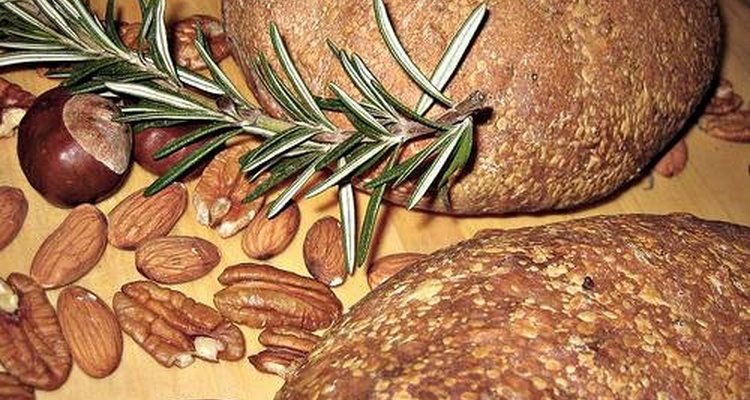
Artisan bread has become such a sensation in recent years that an international competition has developed around making this wholesome bread. Each year, artisan bakers gather at the Coupe du Monde de la Boulangerie competition in Paris to bake the world's best artisan breads. There are a few identifying factors that set artisan bread apart from what is found in most grocery stores.
History
All breads were artisan in the days before mass production of bread began and before preservatives were added so that bread could be stored for longer periods. Mass-produced breads tend to be enriched with vitamins or minerals that were lost because of over-processing. Hearty and wholesome artisan breads are more common in Italy and France. They have become more popular elsewhere, as well, as people have become more aware of their health.
Ingredients
Typically, only a few, simple ingredients are used in artisan breads. The main ingredients are water, salt, flour and yeast. Sourdough artisan bread often does not use yeast. A few other ingredients may be used to flavor the bread, such as cheese, herbs, nuts, milk, garlic, eggs and butter. Artisan bread does not contain preservatives, and thus does not last as long as breads that do.
Baker
Artisan bread typically is made in small local bakeries, where workers are trained in each step of the bread-making process. Artisan bread is made in small batches.
Process
A fermentation process of natural bacteria accounts for the distinctive taste of artisan breads. Each type of bread has its distinctive taste. Sourdough, which tastes rustic, often needs a mixture of flour and water with vitamin C added. The vitamin C helps to stimulate the action of the yeast. Sourdough typically needs a malted barley flour to help the bread achieve its rustic taste. Dough for artisan breads can be kneaded by hand or with an electric mixer. A cooking stone is used to bake the bread.
Types
Each country has its popular types of artisan bread. In Italy, focaccia bread is popular. Focaccia usually contains more oil and is flavored with various herbs. In France, brioche bread is popular. Cheese is baked on the outside, and stuffed on the inside of this bread. Babka is popular in the Ukraine, and is made with butter, eggs, sugar and milk. It is a sweeter-tasting bread.
Related Articles

The History of Bread Pudding
List of Greek Breads
Russian Rye Bread vs. Pumpernickel
What Are Rusk Crumbs?
Differences Between French & Italian ...
Does Heat Kill Lactobacillus Bacteria ...
What Is the Difference Between a Bagel ...
How to Bake Bread in the Oven
How to Freeze Brioche

How to Make Bread Chewy

How to Make Communion Bread Wafers
The Benefits of Essene Bread
What Is Rusk Bread?

How to Keep Sandwich Bread Fresh All ...

Facts About Italian Cuisine
What Is Indian Flat Bread Called?

Does Yeast Cause Holes in Bread?

5 Examples of Yeast Breads
How to Make Bread Tender
Uses of Cassava Flour
References
Writer Bio
Based in Ann Arbor, Mich., Robin Coe has reported on a variety of subjects for more than 15 years. Coe has worked on environmental health and safety issues in communities across Ohio and Michigan. Coe holds a Bachelor of Science in journalism with a double-major in international politics from Bowling Green State University. She has also received training and experience as a nurse aide.
Photo Credits
photo by Foooooey, http://www.flickr.com/photos/fooey/290844567/