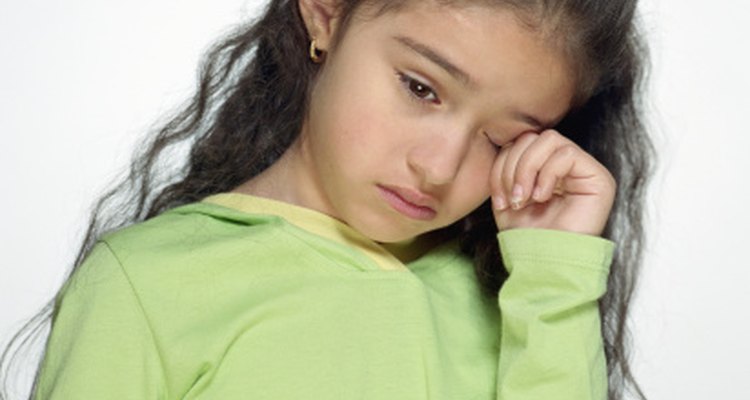
When most people think of child abuse, they think of physical aggression that leaves a child visibly harmed. However, child abuse can also be mental and have long lasting detrimental effects on a child's emotional well-being. The signs indicating that a child is being mentally abused are often harder to detect than those of physical child abuse, but it is necessary to be able to spot them and get the child out of the abusive situation as quickly as you can. If you know of a child who exhibits signs of mental abuse, notify the police or your local child services center as soon as possible.
Passivity and Compliance
Children who are mentally abused often fear acting out in any way that may result in being verbally insulted or neglected for a lengthy period of time. The result is that they behave in an overly cooperative manner to avoid upsetting their abusers. They will immediately agree to do whatever it is they are told without any resistance and are hesitant to speak up to adults even when asked for their opinion on a matter.
Lack of Self-Esteem
Many mentally abused children are repeatedly made to feel like failures and disappointments to their abusers. As a result, they hold very negative opinions of their own worth and may insult themselves, develop eating disorders, regularly second-guess themselves, or even attempt suicide. They may make self-deprecating remarks such as "I'm sorry, I'm so stupid" or find it difficult to accept compliments from others. Another thing to look out for is a child who frequently apologizes for his or her actions, even when no apology is warranted.
Adult-Like Bearing
Some mentally abused children are forced to mature at unusually fast rates and may therefore care for siblings and other children in ways that a parent or guardian would. A young child who feeds, rocks, or changes the diapers of a baby sibling or talks about doing such things at home may be facing mental abuse. Also included in this category are behaviors such as scolding other children or giving them instructions with the authority of a teacher or a parent.
Infantile Behavior
The converse of behaving unusually adult-like is behaving in an excessively infantile way. Some mentally abused children regress into an infant-like state and exhibit behaviors such as rocking, thumb-sucking, biting and throwing tantrums at ages when most children have already outgrown such behaviors. These behaviors are often attempts at self-comforting, whereby a child who cannot rely on a caregiver for comfort learns to rely on himself.
Difficulty Performing in School
Children who are mentally abused while at home may find it hard to focus on schoolwork. They are too preoccupied with thoughts related to the abuse to pay attention in the classroom or are not able to complete homework while at home. While poor grades alone are often the result of factors other than child abuse, it is important to evaluate the reasons why a child is having difficulty in school to rule out the possibility of abuse and get the child the assistance she needs.
Related Articles

Signs of a Troubled Child

The Effects of Children Witnessing ...

How Does a Bad Childhood Affect ...
Three Warning Signs of Neglect

Child Runaway Laws

The Long-Term Effects of Being ...

What Is Identity Crisis During ...

How to Deal With an Abusive Sibling

What Is Healthy Jealousy?

What Is Relationship Bullying?

Signs & Symptoms of a Jealous Sister

Signs You Are Married to a Bully

Traumatic Effects of a Bad Marriage on ...

Signs of a Weak Character

How to Communicate Effectively With ...
How to Spot an INTP

Psychological Effects of Fatherlessness

The History of School Uniform
How Children Are Affected When Living ...
Warning Signs That a Women Was Sexually ...
References
Writer Bio
Dawn Westin is an experienced professional writer who has contributed articles to publications including "South Magazine" and "The Inkwell." She holds a BA in English and professional communications from Armstrong Atlantic State University and currently takes courses at Georgia Southern University in hopes of soon enrolling in medical school.
Photo Credits
Tom Le Goff/Photodisc/Getty Images